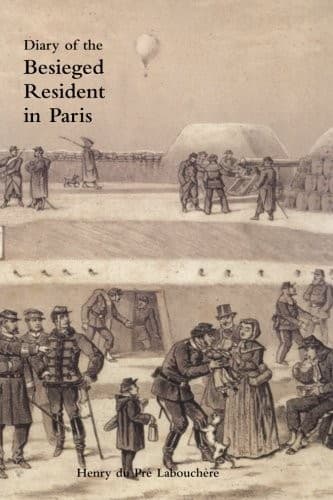
Diary of the Besieged Resident in ParisLabouchere, Henry Du Pré
History
Diary of the Besieged Resident in Paris
Labouchere, Henry Du Pré
Franco-Prussian War, 1870-1871; Paris (France) -- History -- Siege, 1870-1871 -- Personal narratives
A good deal of discussion is going on as to the time which it will take
to revictual Paris; it is thought that it can be done in seven days, but
I do not myself see how it is to be done in anything like this time. One
of the principal English bankers here has, I understand, sent an agent
by balloon to buy boats of small draught in England, in order to bring
provisions up the Seine. As a speculation, I should imagine that the
best plan would be to amass them on the Belgian or Luxemburg frontier.
About two-thirds of the population will be without means to buy food,
even if the food were at their doors. Trade and industry will not revive
for some time; they will consequently be entirely dependent upon the
State for their means of subsistence. Even if work is offered to them,
many of them not be able at once to reassume their habits of daily
industry; the Bohemian life which they have led for the last four
months, and which they are still leading, is against it. A siege is so
abnormal a condition of things, that the State has been obliged to pay
them for doing practically nothing, as otherwise they would have fallen
into the hands of the anarchists; but this pottering about from day to
day with a gun, doing nothing except play at billiards and drink, has
been very demoralising, and it will be long before its effect ceases to
be felt.
The newspapers are somewhat irreverent over the diplomatic protest
against the bombardment. They say that while Paris is deserted by the
Great European Powers, it is a source of pleasure to think that the
Principality of Monaco and the Republics of San Marino and Honduras
still stand by her. They suggest that M. Jules Favre should go to
Andorre to endeavour to induce that republic also to reason with the
Prussians upon the bombardment. I am told that the "proud young porter,"
who now the sheep is dead, represents alone the Majesty of England at
the British Embassy is indignant at not having been invited to add his
signature to the protest. He considers--and justly I think--that he is a
far more important personage than the Plenipotentiary of his Highness of
Monaco; a despot who exercises sway over about 20 acres of orange trees,
60 houses, and two roulette tables. The diplomatists are not, however,
alone in their protest. Everybody has protested, and is still
protesting. If it is a necessity of war to throw shells into a densely
populated town like this; it is--to say the least--a barbarous
necessity; but it seems to me that it is but waste of time and paper to
register protests against it; and if it be thought desirable to do so,
it would be far more reasonable to protest against human beings--women
and children--being exposed to its effects, than to indite plaintive
elegies about the possibility of the Venus de Milo being damaged, or the
orchids in the hot-houses being killed. I know that, for my part, I
would rather that every statue and every plant in the world were smashed
to atoms by shells, than that I were.
Public-domain text, read in full here on John Shaqi.
Reviews
Reviews
No reviews yet
Be the first to share your thoughts on this work.
Elsewhere in the archive
Join the Discussion
Join the discussion
Sign in to leave a comment or review.
Sign InorCreate an account