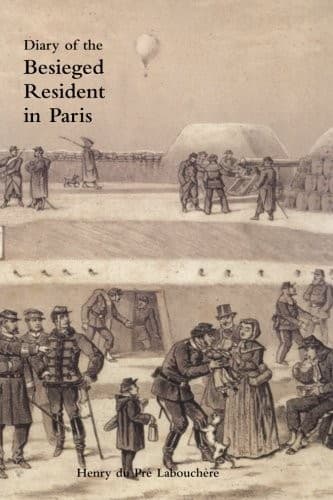
Diary of the Besieged Resident in ParisLabouchere, Henry Du Pré
History
Diary of the Besieged Resident in Paris
Labouchere, Henry Du Pré
Franco-Prussian War, 1870-1871; Paris (France) -- History -- Siege, 1870-1871 -- Personal narratives
The bombardment still continues. Bombs fall into the southern part of
the town; but habit in this world is everything, and no one troubles
himself much about them. At night the Trocadero has become a fashionable
lounge for the _cocottes_, who still honour us with their presence. The
line of the Prussian batteries and the flash of their guns can be seen.
The hissing, too, of the bombs can be heard, when the _cocottes_ crouch
by their swains in affected dread. It is like Cremorne, with its ladies
and its fireworks. Since yesterday morning, too, St. Denis has been
bombarded. Most of its inhabitants have taken refuge in Paris, but it
will be a pity if the cathedral, with the tombs of all the old French
Kings, is damaged. St. Denis is itself a species of fort. Its guns are
not, a friend tells me who has just come from there, replying with
vigour. The Prussians are firing on it from six separate batteries, and
it is feared that it will fall. Our attention to-day has been diverted
from the Prussians outside by a little domestic quarrel at home, and we
have been shooting each other, as though the Prussian missiles were not
enough for our warlike stomachs, and death were not raging around our
prison.
Between twelve and one this morning a band of armed patriots appeared
before the prison of Mazas, and demanded the release of Flourens and the
political prisoners who were shut up there. The director, instead of
keeping the gate shut, allowed a deputation to enter. As soon as the
gate was opened, not only the deputation, but the patriots rushed in,
and bore off Flourens and his friends in triumph. With the Mayor at
their head, they then went to the Mairie of the 20th Arrondissement, and
pillaged it of all the rations and bread and wine which they found
stored up there. Then they separated, having passed a resolution to go
at twelve o'clock to the Hotel de Ville, to assist their "brothers" in
turning out the Government. I got myself to the Place of the Hotel de
Ville at about two o'clock. There were then about 5000 persons there.
The gates were shut. Inside the rails before them were a few officers;
and soldiers could be seen at all the windows. Some few of the 5000 were
armed, but most of them were unarmed. Close in by the Hotel de Ville
there seemed to be some sort of military order in the positions occupied
by the rioters. I took up my stand at the corner of the Rue de Rivoli.
Every moment the crowd increased. It was composed partly of sightseers,
for on Sunday every one is out of doors; partly of sympathisers. These
sympathisers were not, as on October 31, working men, but mainly what
Count Bismarck would call the populace. Their political creed may be
summed up by the word "loot;" their personal appearance by the word
"hangdog." I found myself in the midst of a group of hangdogs, who were
abusing everyone and everything. On one side of me was a lady of
expansive figure, whose breath showed that she had partaken lately of
Public-domain text, read in full here on John Shaqi.
Reviews
Reviews
No reviews yet
Be the first to share your thoughts on this work.
Elsewhere in the archive
Join the Discussion
Join the discussion
Sign in to leave a comment or review.
Sign InorCreate an account