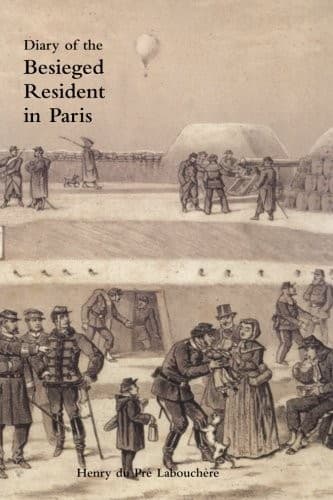
Diary of the Besieged Resident in ParisLabouchere, Henry Du Pré
History
Diary of the Besieged Resident in Paris
Labouchere, Henry Du Pré
Franco-Prussian War, 1870-1871; Paris (France) -- History -- Siege, 1870-1871 -- Personal narratives
ardent spirits, and whose conversation showed that if she was a "matron
of Cornelia's mien," her morals were better than her conversation. "The
people are slaves," she perpetually yelled, "they will no longer submit
to traitors; I say it to you, I, the mother of four children." The
maternal vantage ground which she assumed evidently gave her opinions
weight, for her neighbours replied, "Oui, elle a raison, la mere." A
lean, bilious-looking fellow, who looked as though through life he had
not done an honest day's work, and whose personal charms were not
heightened by a grizzled beard and a cap of cat-skin, close by the
matron, was bawling out, "The Hotel de Ville belongs to us, I am a
taxpayer;" whilst a youth about fifteen years old, hard by, explained in
a shrill treble the military errors which Trochu and the generals had
committed. At a little after three o'clock, a fresh band, all armed,
with a drum, beating the charge, appeared, and as they neared the chief
entrance of the Hotel de Ville, just one shot, and then a number of
shots were fired. Everybody who had a gun then shot it off with an eager
but general idea of doing something, as he fled, like a Parthian bowman.
The stampede soon became general; numbers of persons threw themselves on
the ground. I saw the mother of four children sprawling in the mire, and
the bilious taxpayer fall over her, and then I followed the youthful
strategist into an open door. Inside were about twenty people. The door
was shut to, and for about twenty minutes we heard muskets going off.
Then, as the fight seemed over, the door was opened and we emerged. The
Place had been evacuated by the mob, and was held by the troops. Fresh
regiments were marching on it along the quay and the Rue de Rivoli.
Wounded people were lying about or crawling towards the houses. Soon
some _brancardiers_ arrived and picked up the wounded. One boy I saw
evidently dying--the blood was streaming out of two wounds. The windows
of the Hotel de Ville were broken, and the facade bore traces of balls,
as did some of the houses round the Place. I remained until dusk. Even
when I left the streets were full of citizens. Each man who had rolled
in the mire, and whose clothes showed traces of it, was the centre of a
group of sympathisers and non-sympathisers, to whom he was explaining
how the Breton brigands had fired on him, a poor innocent lamb, who had
done no harm. The non-sympathisers, however, were in the majority, and
"served him right" seemed to be the general verdict on those who had
been shot, or who had spoilt their clothes. Every now and then some
window would slam or a cart would rumble by, when there would be a
general scamper for a few yards. After dinner I again returned to the
Hotel de Ville. The crowd had dispersed, and the Place was militarily
occupied; so we may suppose that this little domestic episode is over.
_January 23rd, morning._
Public-domain text, read in full here on John Shaqi.
Reviews
Reviews
No reviews yet
Be the first to share your thoughts on this work.
Elsewhere in the archive
Join the Discussion
Join the discussion
Sign in to leave a comment or review.
Sign InorCreate an account