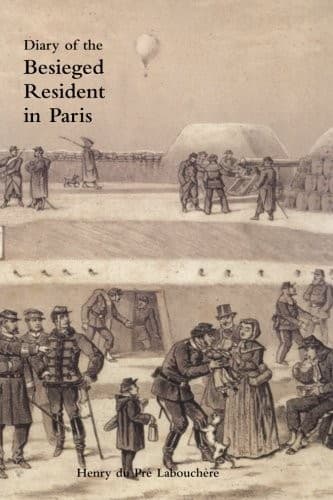
Diary of the Besieged Resident in ParisLabouchere, Henry Du Pré
History
Diary of the Besieged Resident in Paris
Labouchere, Henry Du Pré
Franco-Prussian War, 1870-1871; Paris (France) -- History -- Siege, 1870-1871 -- Personal narratives
Their surprise at seeing the
Prussians victors at the doors of Paris, is much that which the
Americans would feel if a war with the Sioux Indians were to bring these
savages to the suburbs of New York. The French have now learnt that they
are not invincible, and that if war may mean victory, it may also mean
defeat, invasion, and ruin. When, therefore, they have paid the bill for
their _a Berlin_ folly, they will think twice before they open a fresh
account with fortune.
I would recommend sightseers to defer their visit to Paris for the
present, as during the armistice it will not be a very pleasant
residence for foreigners. I doubt whether the elections will go off, and
the decisions of the National Assembly be known without disturbances.
The vainest of the vain, irritable to madness by their disasters, the
Parisians are in no humour to welcome strangers. The world has held
aloof whilst the "capital of civilisation" has been bombarded by the
"hordes of Attila," and there is consequently, just now, no very
friendly feeling towards the world.
Of news, there is very little. We are in a state of physical and moral
collapse. The groups of patriots which invested the Boulevards on the
first announcement of the capitulation have disappeared; and the
gatherings of National Guards, who announced their intention to die
rather than submit, have discontinued their sittings, owing it, as they
said, to their country to live for her. No one hardly now affects to
conceal his joy that all is over. Every citizen with whom one speaks,
tells you that it will be the lasting shame of Paris that with its
numerous army it not only failed to force the Prussians to raise the
siege, but also allowed them whenever they pleased to detach corps
d'armee against the French generals in the provinces. This, of course,
is the fault of the Government of Trochu and of the Republic, and having
thus washed his hands of everything that has occurred, the citizen goes
on his way rejoicing. The Mobiles make no secret of their delight at the
thought of getting back to their homes. Whatever the Parisians may think
of them, they do not think much of the Parisians. The army, and more
particularly the officers, are very indignant at the terms of the
armistice. They bitterly say that they would far rather have preferred
to have been made prisoners of war at once, and they feel that they are
in pawn in Paris, a pledge that peace will be made. M. Jules Ferry was
treated so coldly the other day by General Vinoy's staff, when he went
upon some business to the headquarters of the Commander-in-Chief, that
he asked the cause, and was told in plain terms that he and his
colleagues had trifled with the honour of the army. The armistice was,
as you are aware, concluded by M. Jules Favre in person. It was then
thought necessary to send a General to confer with Count Moltke on
matters of detail. General Trochu seized upon this occasion to assert
Public-domain text, read in full here on John Shaqi.
Reviews
Reviews
No reviews yet
Be the first to share your thoughts on this work.
Elsewhere in the archive
Join the Discussion
Join the discussion
Sign in to leave a comment or review.
Sign InorCreate an account