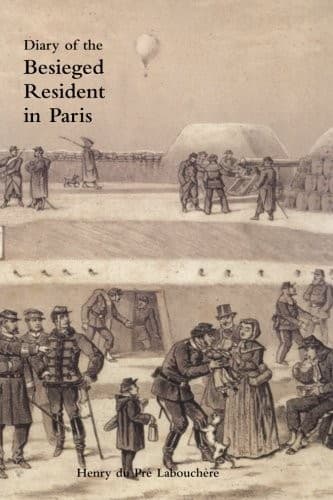
Diary of the Besieged Resident in ParisLabouchere, Henry Du Pré
History
Diary of the Besieged Resident in Paris
Labouchere, Henry Du Pré
Franco-Prussian War, 1870-1871; Paris (France) -- History -- Siege, 1870-1871 -- Personal narratives
himself, and requested to be allowed to send a General of his choice,
saying that his book which he published in 1867 must be so well known at
the German headquarters, that probably his envoy would meet with
peculiar respect. To this General Vinoy acceded, but Count Moltke
refused to treat with Trochu's General, who was drunk, and the chief of
General Vinoy's staff had to be substituted. General Ducrot is still
here. He resigned his command, not as is generally supposed, because the
Prussians insisted upon it in consequence of his evasion from Sedan, but
because General Vinoy on assuming the command of the army gave him a
very strong hint to do so. "I did not"' observed Vinoy, "think your
position sufficiently _en regle_ to serve under _you_, and so----"
The question of the revictualling is the most important one of the
moment. The railroad kings, who had an interview with Count Bismarck at
Versailles, seem to be under the impression that this exceedingly
wide-awake statesman intends to throw impediments in the way of Paris
getting provisions from England, in order that the Germans may turn an
honest penny by supplying the requirements of the town. He has thrown
out hints that he himself can revictual us for a short time, if it
really be a question of life and death. Even when the lines are opened
to traffic and passengers, the journey to England, _via_ Amiens, Rouen,
and Dieppe will be a tedious one. The Seine, we learn, has been rendered
impassable by the boats which have been sunk in it.
We have as yet had no news from outside. The English here find the want
of a consul more than ever. The Foreign Office has sent in an acting
commission to Mr. Blount, a gentleman who may be an excellent banker,
but knows nothing of consular business, notwithstanding his courtesy. As
whenever any negotiation is to take place at a foreign court a Special
Envoy is sent, and, as it now appears, whenever a Consul is particularly
wanted in a town a Special Consul is appointed, would it not be as well
at once to suppress the large staff of permanent ambassadors, ministers,
and consuls who eat their heads off at a heavy cost to the country. I
should be curious to know how many years it would take to reduce the
intelligence of an ordinary banker's clerk to the level of a Foreign
Office bureaucrat. How the long-suffering English public can continue to
support the incompetency and the supercilious contempt with which these
gentry treat their employers is to me a mystery. Bureaucrats are bad
enough in all conscience, but a nest of fine gentleman bureaucrats is a
public curse, when thousands are subjected to their whims, their
ignorance, and their airs.
Public-domain text, read in full here on John Shaqi.
Reviews
Reviews
No reviews yet
Be the first to share your thoughts on this work.
Elsewhere in the archive
Join the Discussion
Join the discussion
Sign in to leave a comment or review.
Sign InorCreate an account