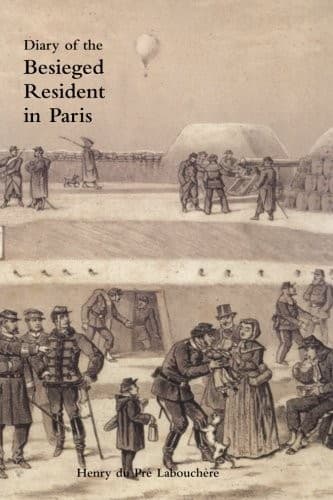
Diary of the Besieged Resident in ParisLabouchere, Henry Du Pré
History
Diary of the Besieged Resident in Paris
Labouchere, Henry Du Pré
Franco-Prussian War, 1870-1871; Paris (France) -- History -- Siege, 1870-1871 -- Personal narratives
The Republic is in very bad odour just now. It has failed to save
France, and it is rendered responsible for this failure. Were the Comte
de Paris a man of any mark, he would probably be made King. As it is,
there is a strong feeling in favour of his family, and more particularly
in favour of the Duc d'Aumale. Some talk of him as President of the
Republic, others suggest that he should be elected King. The
Bonapartists are very busy, but as regards Paris there is no chance
either for the Emperor or the Empress Regent. As for Henri V., he is, in
sporting phraseology, a dark horse. Among politicians, the general
opinion is that a moderate Republic will be tried for a short time, and
that then we shall gravitate into a Constitutional Monarchy.
Little heed is taken of the elections which are so close at hand. No one
seems to care who is elected. As it is not known whether the National
Assembly will simply register the terms of peace proposed by Germany,
and then dissolve itself, or whether it will constitute itself into an
_Assemblee Constituante_, and decide upon the future form of government,
there is no Very great desire among politicians to be elected to it.
Several Electoral Committees have been formed, each of which puts
forward its own list--that which sits under the Presidency of M.
Dufaure, an Orleanist, at the Grand Hotel, is the most important of
them. Its list is intended to include the most practical men of all
parties; the rallying cry is to be France, and in theory its chiefs are
supposed to be moderate Republicans.
The ceremony of the giving up of the forts has passed over very quietly.
The Prussians entered them without noise or parade. At St. Denis, the
mayor of which said that no Prussian would be safe in it, friends and
foes, I am told by a person who has just returned, have fraternised, and
are pledging each other in every species of liquor. The ramparts are
being dismantled of their guns; the National Guard no longer does duty
on them, and crowds assemble and stare vaguely into the country outside.
During the whole siege Paris has not been so dismal and so dreary as it
is now. There is no longer the excitement of the contest, and yet we are
prisoners. The only consolation is that a few weeks will put an end to
this state of things.
CHAPTER XIX.
_February 1st._
The Government of National Defence has almost disappeared from notice.
It has become a Committee to preside over public order. The world may
calumniate us, they said in a proclamation the other day. It would be
impossible, replied the newspapers. Trochu and Gambetta, once the idols
of the Parisians, are now the best abused men in France. Trochu (a
friend of his told me to-day) deserted by all, makes speeches in the
bosom of his family. No more speeches, no more lawyers; is the cry of
the journals. And then they spin out phrases of exaggerated Spartanism
by the yard, and suggest some lawyer as the rising hope of the country.
Public-domain text, read in full here on John Shaqi.
Reviews
Reviews
No reviews yet
Be the first to share your thoughts on this work.
Elsewhere in the archive
Join the Discussion
Join the discussion
Sign in to leave a comment or review.
Sign InorCreate an account