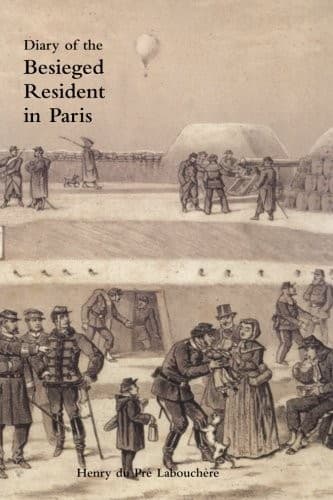
Diary of the Besieged Resident in ParisLabouchere, Henry Du Pré
History
Diary of the Besieged Resident in Paris
Labouchere, Henry Du Pré
Franco-Prussian War, 1870-1871; Paris (France) -- History -- Siege, 1870-1871 -- Personal narratives
I have been this morning sitting with a friend who, under the promise of
the strictest secrecy, has given me an account of the condition of
affairs here. I trust, therefore, that no one will mention anything that
may be found in this letter, directly or indirectly relating to the
Prussians. The old King, it appears, is by no means happy as an Emperor.
He was only persuaded to accept this title for the sake of his son, "Our
Fritz," and he goes about much like some English squire of long descent,
who has been induced to allow himself to be converted into a bran new
peer, over-persuaded by his ambitious progeny. William is one of that
numerous class of persons endowed with more heart than brains. Putting
aside, or regarding rather as the delusion of a diseased brain, his
notion that he is an instrument of Heaven, and that he is born to rule
over Prussian souls by right divine, the old man is by no means a bad
specimen of a good-natured, well-meaning, narrow-minded soldier of the
S.U.S.C. type; and between Bismarck and Moltke he has of late had by no
means an easy time. These two worthies, instead of being, as we imagined
in Paris, the best of friends, abominate each other. During the siege
Moltke would not allow Bismarck to have a seat at any council of war;
and in order to return the compliment, Bismarck has not allowed Moltke
to take any part in the negotiations respecting the armistice, except on
the points which were exclusively military. Bismarck tells the French
that had it not been for him, Paris would have been utterly destroyed,
while Moltke grumbles because it has not been destroyed; an achievement
which this talented captain somewhat singularly imagines would fittingly
crown his military career. But this is not the only domestic jar which
destroys the harmony of the happy German family at Versailles. In
Prussia it has been the habit, from time immemorial, for the heir to the
throne to coquet with the Liberals, and to be supposed to entertain
progressive opinions. The Crown Prince pursues this hereditary policy of
his family. He has surrounded himself with intelligent men, hostile to
the present state of things, and who understand that in the present age
110 country can be great and powerful, where all who are not country
gentlemen, chamberlains, or officers, are excluded from all share in its
government. Bismarck, on the other hand, is the representative, or
rather the business man, of the squirearchy and of the Vons--much in the
same way as Mr. Disraeli is of the Conservatives in England; and, like
the latter, he despises his own friends, and scoffs at the prejudices, a
pretended belief in which has served them as a stepping-stone to power.
The consequence of this divergency of opinion is, that Bismarck and "Our
Fritz" are very nearly what schoolboys call "cuts," and consequently
when the old King dies, Bismarck's power will die with him, unless he is
wise enough to withdraw beforehand from public life. "Our Fritz," I
Public-domain text, read in full here on John Shaqi.
Reviews
Reviews
No reviews yet
Be the first to share your thoughts on this work.
Elsewhere in the archive
Join the Discussion
Join the discussion
Sign in to leave a comment or review.
Sign InorCreate an account