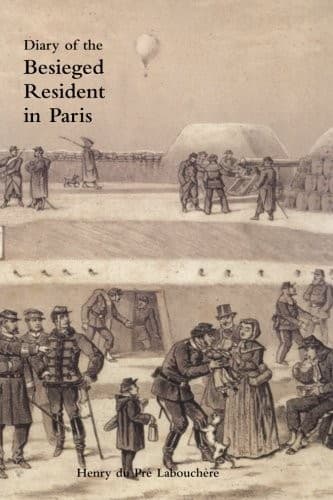
Diary of the Besieged Resident in ParisLabouchere, Henry Du Pré
History
Diary of the Besieged Resident in Paris
Labouchere, Henry Du Pré
Franco-Prussian War, 1870-1871; Paris (France) -- History -- Siege, 1870-1871 -- Personal narratives
hear, has done his best to prevent the Prussian batteries from doing any
serious damage to Paris, and has not concealed from his friends that he
considers that the bombardment was, in the words of Fouche, worse than a
crime--an error.
I find many of the Prussian officers improved by success. Those with
whom I have come in personal contact have been remarkably civil and
polite, but I confess that--speaking of course generally--the sight of
these mechanical instruments of war, brought to the highest state of
perfection in the trade of butchery, lording it in France, is to me most
offensive. I abhor everything which they admire. They are proud of
walking about in uniform with a knife by their side. I prefer the man
without the uniform and without the knife. They despise all who are
engaged in commercial pursuits. I regard merchants and traders as the
best citizens of a free country. They imagine that the man whose
ancestors have from generation to generation obscurely vegetated upon
some dozen acres, is the superior of the man who has made himself great
without the adventitious aid of birth; I do not. When Jules Favre met
Bismarck over here the other day, the latter spoke of Bourbaki as a
traitor, because he had been untrue to his oath to Napoleon. "And was
his country to count for nothing?" answered Favre. "In Germany king and
country are one and the same," replied Bismarck. This is the abominable
creed which is inculcated by the military squires who now hold the
destinies of France and of Germany in their hands; and on this
detestable heresy they dream of building up a new code of political
ethics in Europe. Liberalism and common sense are spreading even in the
army; but take a Tory squire, a Groom of the Chamber, and a
Life-guardsman, boil them down, and you will obtain the ordinary type of
the Prussian officer. For my part, I look with grim satisfaction to the
future. The unity of Germany has been brought about by the union of
Prussian Feudalists and German Radicals. The object is now attained, and
I sincerely hope that the former will find themselves in the position of
cats who have drawn the chestnuts out of the fire for others to eat. If
"Our Fritz," still following in the steps of his ancestors, throws off
his Liberalism with his Crown Princedom, his throne will not be a bed of
roses; it is fortunate, therefore, for him, that he is a man of good
sense. I am greatly mistaken if the Germans will long submit to the
horde of squires, of princes, of officers, and of court flunkeys, who
together, at present, form the ruling class. Among the politicians here
there is a strong feeling of dislike to the establishment of a Republic
in France. If they could have their own way they would re-establish the
Empire. But those who imagine that this is possible understand very
little of the French character. The Napoleonic legend was the result of
an epoch of military glory; the capitulation of Sedan not only scotched
it, but killed it.
Public-domain text, read in full here on John Shaqi.
Reviews
Reviews
No reviews yet
Be the first to share your thoughts on this work.
Elsewhere in the archive
Join the Discussion
Join the discussion
Sign in to leave a comment or review.
Sign InorCreate an account