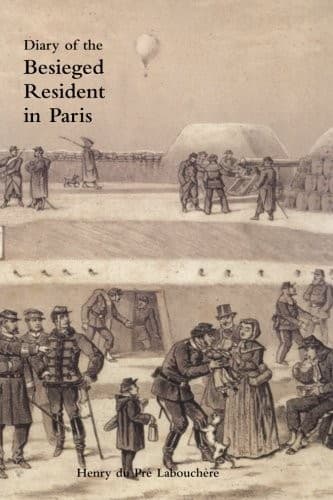
Diary of the Besieged Resident in ParisLabouchere, Henry Du Pré
History
Diary of the Besieged Resident in Paris
Labouchere, Henry Du Pré
Franco-Prussian War, 1870-1871; Paris (France) -- History -- Siege, 1870-1871 -- Personal narratives
Marat! We will do justice ourselves...." The ultra-Republicans, of the
stamp of M. Blanqui and M. Felix Pyat, seem to be under the impression
that it is far more important to establish a Republican form of
Government in France than to resist the Prussians. In the meetings which
they hold every evening they clamour for the election at once of a
municipality, because they hope to become themselves members of it, and
then to absorb all the power which is now wielded by the Provisional
Government. Beyond discrediting themselves by these attempts to disturb
the harmony within the walls, which is of such vital importance at the
present moment, I do not think that they will do much. I have talked to
many working men, and whatever may be their political opinions, they are
far too sensible to play the game of the Prussians by weakening the
existing Government. After the Prussians perhaps the deluge; but as long
as they are before Paris, and the Provisional Government does not
capitulate, I do not dread any political disorders. What we may come to,
are bread riots. There is already an immense deal of misery, and, as the
siege continues and provisions rise in price, it will of course
increase.
I was talking this morning to a gentleman who used at one time to play a
very important part in public life, who is well acquainted with most of
the members of the Government, and who is a man of calm judgment. I was
anxious to obtain his opinion upon the situation, and this is a _resume_
of what he told me. "When Jules Favre," he said, "went to Bismarck, he
was prepared to agree to the dismantlement of the fortresses of Alsace
and Lorraine, the cession of half the fleet, the payment of an indemnity
of eighty millions of pounds, and an agreement for a term of years not
to have a standing army of more than 200,000 men. A Constituent Assembly
would have ratified these terms. The cession of a portion of the fleet
is but tantamount to the payment of money. The conscription is so
unpopular that a majority of the nation would have been glad to know
that the standing army would henceforward be a small one. As for the
fortresses, they have not been taken, and yet they have not arrested the
Prussian advance on Paris; consequently their destruction would not
seriously weaken the defences of the country." I asked whether Paris
would now consent to these terms. "No," he said, "if the Government
offered them there would be a revolution. Paris, rightly or wrongly,
believes that she will be able to hold out for two months, and that
during this time there will be a _levee en masse_." "And do you share
this opinion?" I asked. "I am not of a very sanguine character" he
replied; "but I really am now inclined to believe that the Prussians
will never enter Paris unless they starve us into a surrender." "Then,"
I said, "I suppose they will starve us out." "I am an old man," he said,
"and I always remember Philip's saying, 'Time and I are two,' In two
months many things may happen.
Public-domain text, read in full here on John Shaqi.
Reviews
Reviews
No reviews yet
Be the first to share your thoughts on this work.
Join the Discussion
Join the discussion
Sign in to leave a comment or review.
Sign InorCreate an account