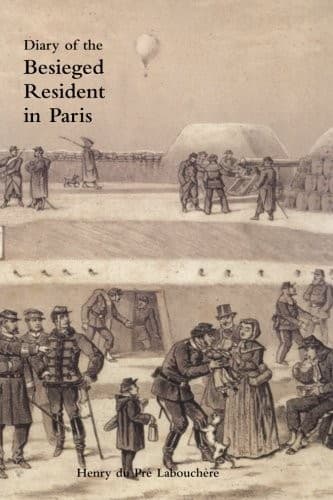
Diary of the Besieged Resident in ParisLabouchere, Henry Du Pré
History
Diary of the Besieged Resident in Paris
Labouchere, Henry Du Pré
Franco-Prussian War, 1870-1871; Paris (France) -- History -- Siege, 1870-1871 -- Personal narratives
We are still beating our tom-toms like the Chinese, to frighten away the
enemy, and our braves still fire off powder at invisible Uhlans. The
Prussians, to our intense disgust, will not condescend even to notice
us. We jeer at them, we revile them, and yet they will not attack us.
What they are doing we cannot understand. They appear to have withdrawn
from the advanced positions which they held. We know that they are in
the habit of making war in a thoroughly ungentlemanly manner, and we
cannot make up our minds whether our "attitude" is causing them to
hesitate, or whether they are not devising some new trick to take us by
surprise. That they are starving, that their communications with Germany
are cut off, that their leaders are at loggerheads, that the Army of the
Loire will soon be here to help us to demolish them, we have not the
slightest doubt. The question is no longer whether Paris will be
taken--that we have solved already--it is whether the Prussians will be
able to get back to the Rhine. We are thankful that Bismarck did not
accept Jules Favre's offer of a money indemnity. We would not give a
hundred francs now to ensure peace or an armistice. I went this morning
into a shop, the proprietor of which, a bootmaker, I have long known,
and I listened with interest to the conversation of this worthy man
with some of his neighbours who had dropped in to have a gossip, and to
congratulate him on his martial achievements, as he had been on guard in
a bastion. We first discussed why the Army of the Loire had not arrived,
and we came to the conclusion that it was engaged in rallying Bazaine.
"I should like to read your English newspapers now," said one; "your
_Tims_ told us we ought to cede Alsace and Lorraine, but its editor must
now acknowledge that Paris is invincible." I told him that I felt
convinced that he did so regularly every morning. "No peace," shouted a
little tailor, who had been prancing about on an imaginary steed,
killing imaginary Prussians, "we have made a pact with death; the world
knows now what are the consequences of attacking us." The all-absorbing
question of subsistence then came up, and some one remarked that beef
would give out sooner than mutton. "We must learn," observed a
jolly-looking grocer, "to vanquish the prejudices of our stomachs. Even
those who do not like mutton must make the sacrifice of their taste to
their country." I mildly suggested that perhaps in a few weeks the
stomachs which had a prejudice against rats would have to overcome it.
At this the countenance of the gossips fell considerably, when the
bootmaker, after mysteriously closing the door, whispered, "A secret was
confided to me this morning by an intimate friend of General Trochu.
There is a tunnel which connects Paris with the provinces, and through
it flocks and herds are entering the town." This news cheered us up
amazingly. My bootmaker's wife came in to help him off with his military
Public-domain text, read in full here on John Shaqi.
Reviews
Reviews
No reviews yet
Be the first to share your thoughts on this work.
Join the Discussion
Join the discussion
Sign in to leave a comment or review.
Sign InorCreate an account