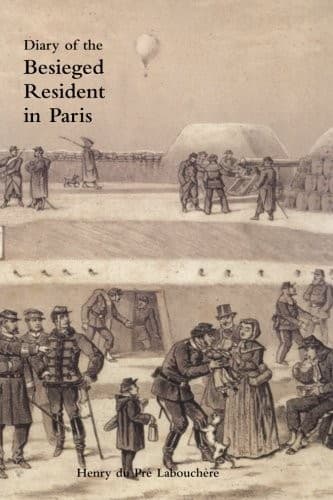
Diary of the Besieged Resident in ParisLabouchere, Henry Du Pré
History
Diary of the Besieged Resident in Paris
Labouchere, Henry Du Pré
Franco-Prussian War, 1870-1871; Paris (France) -- History -- Siege, 1870-1871 -- Personal narratives
Next to the priests and the churches, the streets named after members
and friends of the late Imperial family excite the ire of patriots. The
inhabitants of the quartier Prince Eugene, have, I read to-day, decided
that the Boulevard Prince Eugene shall henceforward be called the
Boulevard Dussault, "the noble child of the Haute Vienne, who was
murdered by the aides of the infamous Bonaparte."
We are not, as you might perhaps suppose, wanting in news. The French
journalists, even when communications with the rest of the world were
open, preferred to evolve their facts from their moral consciousness--their
hand has not lost its cunning. Peasants, who play the part here of the
intelligent contraband of the American civil war, bring in daily the most
wonderful stories of the misery which the Prussians are suffering, and the
damage which our artillery is causing them--and these tales are duly
published. Then, at least three times a week we kill a Prussian Prince,
and "an army" relieves Bazaine. A few days ago a troop of 1500 oxen marched
into our lines, "they were French oxen, and they were impelled by their
patriotism." This beats the ducks who asked the old woman to come and kill
them.
The clubs appear to be divided upon the question of the "commune." In
most of them, however, resolutions have been passed reaffirming their
determination to hold the elections with or without the consent of the
Government. Rochefort to-day publishes a sensible reply to Flourens, who
called upon him to explain why he does not resign. "I have," he says,
"descended into the most impenetrable recesses of my conscience, and I
have emerged with the conviction that my withdrawal would cause a
conflict, and this would open a breach to the Prussians. You will say
that I am capitulating with my convictions; if it be so, I do not
necessarily capitulate with the Prussians. I silence my political
instincts; let our brave friends in Belleville allow theirs to sleep for
a time." I understand that in the council which was held to decide upon
the advisability of adjourning these elections, Rochefort, Simon, Ferry,
and Arago voted against the adjournment, and Pelletan, Garnier Pages,
Picard, and Favre in favour of it. Trochu then decided the question in
the affirmative by a threat that, if the elections were allowed to take
place, he would resign.
_October 11th._
Public-domain text, read in full here on John Shaqi.
Reviews
Reviews
No reviews yet
Be the first to share your thoughts on this work.
Elsewhere in the archive
Join the Discussion
Join the discussion
Sign in to leave a comment or review.
Sign InorCreate an account