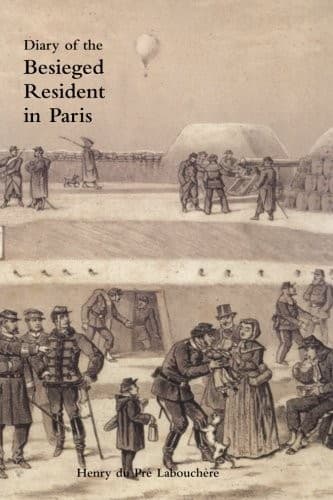
Diary of the Besieged Resident in ParisLabouchere, Henry Du Pré
History
Diary of the Besieged Resident in Paris
Labouchere, Henry Du Pré
Franco-Prussian War, 1870-1871; Paris (France) -- History -- Siege, 1870-1871 -- Personal narratives
The notions of a Pall Mall dandy respecting Southwark or the Tower
Hamlets are not more vague than those of the Parisian bourgeois or the
Professional French journalist respecting the vast Faubourgs peopled by
the working men which encircle this city. From actual observation they
know nothing of them. They believe them to be the homes of a dangerous
class--communistic and anarchical in its tendencies, the sworn foes
alike of law, order, and property. The following are the articles of
faith of the journalist:--France is the world. Paris is France. The
boulevards, the theatres, some fifty writers on the press, and the
bourgeoisie of the fashionable quarters of the city, are Paris. Within
this narrow circle he may reason justly, but he never emerges from it,
and consequently cannot instruct others about what he does not know
himself. Since the fall of the Emperor, the Parisian bourgeois has
vaguely felt that he has been surrounded by two hostile armies--the
Prussian without the walls, and the working men within. He has placed
his trust in Trochu, as twenty years ago he did in Cavaignac. The siege
had not lasted a week before he became convinced that the Prussians were
afraid of him, because they had not attacked the town; and within the
last few days he has acquired the conviction, upon equally excellent
grounds, that the working men also tremble before his martial attitude.
On Friday last he achieved what he considers a crowning triumph, and he
is now under the impression that he has struck terror into the breasts
of the advocates of the Commune by marching with his battalion to the
Hotel de Ville. "We"--and by "we" he means General Trochu and
himself--"we have shown them that we are not to be trifled with," is his
boast from morning to night. Now, if instead of reading newspapers which
only reflect his own views, and passing his time, whether on the
ramparts or in a cafe, surrounded by men who share his prejudices, the
worthy bourgeois would be good enough to accompany me to Belleville or
La Villette, he would perhaps realise the fact that, as usual, he is
making himself comfortable in a fool's paradise. He would have an
opportunity to learn that, while the working men have not the remotest
intention to pillage his shop, they are equally determined not to allow
him and his friends to make Paris the laughing-stock of Europe. With
them the "Commune" is but a means to an end. What they want is a
Government which will carry out in sober earnest M. Jules Favre's
rhetorical figure that "the Parisians will bury themselves beneath the
ruins of their town rather than surrender." The lull in the
"demonstrations" to urge the Government either to carry out this
programme, or to associate with themselves men of energy who are ready
to do so, will not last long; and when next Belleville comes to the
Hotel de Ville, it will not be unarmed. The bourgeois and the working
man worship different gods, and have hardly two ideas in common. The
Public-domain text, read in full here on John Shaqi.
Reviews
Reviews
No reviews yet
Be the first to share your thoughts on this work.
Elsewhere in the archive
Join the Discussion
Join the discussion
Sign in to leave a comment or review.
Sign InorCreate an account