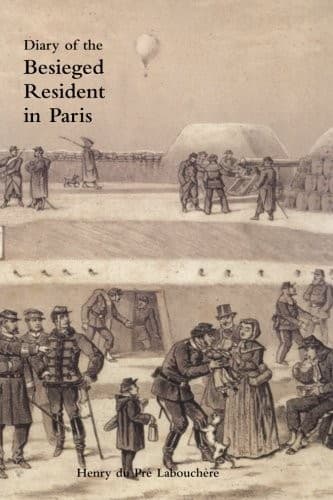
Diary of the Besieged Resident in ParisLabouchere, Henry Du Pré
History
Diary of the Besieged Resident in Paris
Labouchere, Henry Du Pré
Franco-Prussian War, 1870-1871; Paris (France) -- History -- Siege, 1870-1871 -- Personal narratives
bourgeois believes in the Army of the Loire; believes that in
sacrificing the trade profits of a few months, and in catching a cold by
keeping guard occasionally for a night on the ramparts, he has done his
duty towards his country, and deserves the admiration of all future
ages. As for burying himself, beneath, the ruins of his shop, it is his
shop as much as his country that he is defending. He is gradually
wearying of the siege; the pleasure of strutting about in a uniform and
marching behind a drum hardly compensates for the pecuniary losses which
he is incurring. He feels that he is already a hero, and he longs to
repose upon his laurels. When Bazaine has capitulated, and when the
bubble of the Army of the Loire has burst, he will, if left to himself,
declare and actually believe that Paris has surpassed in heroism and
endurance Troy and Saragossa; and he will accept what is inevitable--a
capitulation. The working man, on the other hand, believes in no Army of
the Loire, troubles himself little about Bazaine, and has confidence in
himself alone. Far from disliking the siege, he delights in it. He lives
at free quarters, and he walks about with a gun, that occupation of all
others which is most pleasing to him. He at least is no humbug; he has
no desire to avoid danger, but rather courts it. He longs to form one in
a sortie, and he builds barricades, and looks forward with grim
satisfaction to the moment when he will risk his own life in defending
them, and blow up his landlord's house to arrest the advance of the
Prussians. What will be the upshot of this radical divergence of opinion
between the two principal classes which are cooped up together within
the walls of Paris, it is impossible to say. The working men have, as
yet, no leaders in whom they place confidence, and under whose guidance
they would consent to act collectively. It may be that this will prevent
them from giving effect to their views before the curtain drops; they
are strongly patriotic, and they are disinclined to compromise the
success of the defence by internal quarrels. Very possibly, therefore,
they will be deceived by promises on the part of the Government, and
assurances that Paris will fight it out to the last ditch, until the
moment to act has passed. As for the bourgeois and the Government, their
most powerful ally is the cry, "No division; let us all be united." They
are both, however, in a radically false position. They have called upon
the world to witness how a great capital can die rather than surrender;
and yet, if no external agency prevents the surrender, they have no
intention to fulfil their boast of dying. Any loophole for escape from,
the alternative in which they have thrust themselves they would welcome.
"Our provisions will last three months," they say; "during this time
something must happen to our advantage." "What?" I inquire. "The Army of
the Loire will advance, or Bazaine will get out of Metz, or the
Public-domain text, read in full here on John Shaqi.
Reviews
Reviews
No reviews yet
Be the first to share your thoughts on this work.
Elsewhere in the archive
Join the Discussion
Join the discussion
Sign in to leave a comment or review.
Sign InorCreate an account