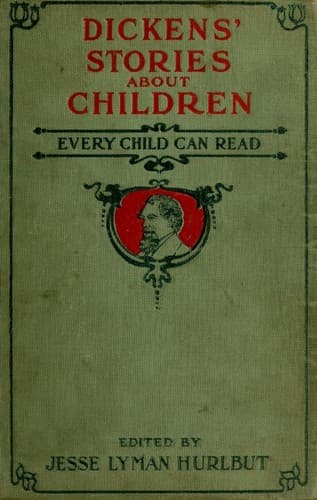
Dickens' Stories About Children Every Child Can Read — John Shaqi
Dickens' Stories About Children Every Child Can ReadDickens, Charles
General
Dickens' Stories About Children Every Child Can Read
Dickens, Charles
Children -- Juvenile fiction; Children's stories, English
Bob could hardly believe his eyes and ears, but it was all true. Such
doings as they had on New Year's day had never been seen before in the
Cratchits' home, nor such a turkey as Mr. Scrooge sent them for dinner.
Tiny Tim had his share too, for Tiny Tim did not die, not a bit of it.
Mr. Scrooge was a second father to him from that day, he wanted for
nothing, and grew up strong and hearty. Mr. Scrooge loved him, and well
he might, for was it not Tiny Tim who had without knowing it, through
the Christmas dream-spirit, touched his hard heart and caused him to
become a good and happy man?
III.
THE RUNAWAY COUPLE.
THE Boots at the Holly Tree Inn was the young man named Cobbs, who
blacked the shoes, and ran errands, and waited on the people at the inn;
and this is the story that he told, one day.
"Supposing a young gentleman not eight years old was to run away with a
fine young woman of seven, would you consider that a queer start? That
there is a start as I--the Boots at the Holly Tree Inn--have seen with
my own eyes; and I cleaned the shoes they ran away in, and they was so
little that I couldn't get my hand into 'em.
"Master Harry Walmers' father, he lived at the Elms, away by Shooter's
Hill, six or seven miles from London. He was uncommon proud of Master
Harry, as he was his only child; but he didn't spoil him neither. He was
a gentleman that had a will of his own, and an eye of his own, and that
would be minded. Consequently, though he made quite a companion of the
fine bright boy, still he kept the command over him, and the child _was_
a child. I was under-gardener there at that time; and one morning
Master Harry, he comes to me and says--
"'Cobbs, how should you spell Norah, if you was asked?' and then begun
cutting it in print, all over the fence.
"He couldn't say he had taken particular notice of children before that;
but really it was pretty to see them two mites a-going about the place
together, deep in love. And the courage of the boy! Bless your soul,
he'd have throwed off his little hat, and tucked up his little sleeves,
and gone in at a lion, he would, if they had happened to meet one and
she had been frightened of him. One day he stops along, with her, where
Boots was hoeing weeds in the gravel, and says--speaking up, 'Cobbs,' he
says, 'I like you.' 'Do you, sir? I'm proud to hear it.' 'Yes, I do,
Cobbs. Why do I like you, do you think, Cobbs?' 'Don't know, Master
Harry, I am sure.' 'Because Norah likes you, Cobbs.' 'Indeed, sir?
That's very gratifying.' 'Gratifying, Cobbs? It's better than millions
of the brightest diamonds to be liked by Norah.' 'Certainly, sir.'
'You're going away, ain't you, Cobbs?' 'Yes, sir.' 'Would you like
another situation, Cobbs?' 'Well, sir, I shouldn't object, if it was a
good 'un.' 'Then, Cobbs,' says he, 'you shall be our head-gardener when
we are married.' And he tucks her, in her little sky-blue mantle, under
his arm, and walks away.
Public-domain text, read in full here on John Shaqi.
Reviews
Reviews
No reviews yet
Be the first to share your thoughts on this work.
Join the Discussion
Join the discussion
Sign in to leave a comment or review.
Sign InorCreate an account