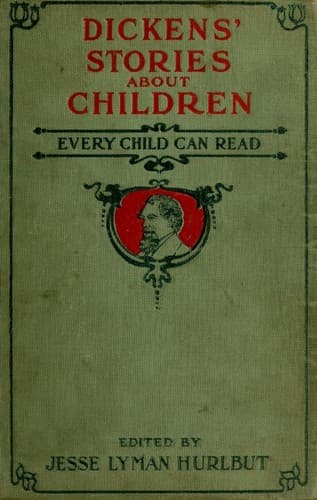
Dickens' Stories About Children Every Child Can ReadDickens, Charles
General
Dickens' Stories About Children Every Child Can Read
Dickens, Charles
Children -- Juvenile fiction; Children's stories, English
For the first time in all those years, she sunk under her cares. She
cried, with her clasped hands lifted above her head, that it would kill
their father if he ever knew it; and fell down at Tip's worthless feet.
It was easier for Tip to bring her to her senses than for her to bring
_him_ to understand that the Father of the Marshalsea would be beside
himself if he knew the truth. Tip thought that there was nothing strange
in being there a prisoner, but he agreed that his father should not be
told about it. There were plenty of reasons that could be given for his
return; it was accounted for to the father in the usual way; and the
collegians, with a better understanding of the kind fraud than Tip,
stood by it faithfully.
This was the life, and this the history, of the Child of the Marshalsea,
at twenty-two. With a still abiding interest in the one miserable yard
and block of houses as her birthplace and home, she passed to and fro in
it shrinking now, with a womanly consciousness that she was pointed out
to everyone. Since she had begun to work beyond the walls, she had found
it necessary to hide where she lived, and to come and go secretly as she
could, between the free city and the iron gates, outside of which she
had never slept in her life. Her original timidity had grown with this
concealment, and her light step and her little figure shunned the
thronged streets while they passed along them.
Worldly wise in hard and poor necessities, she was innocent in all
things else. Innocent, in the mist through which she saw her father, and
the prison, and the dark living river that flowed through it and flowed
on.
[Illustration: "Mr. Clennam Followed Her Home."
Page 65]
This was the life, and this the history, of Little Dorrit, until the son
of a lady, Mrs. Clennam, to whose house Amy went to do needlework,
became interested in the pale, patient little creature. He followed
her to her home one day and when he found that it was the debtor's
prison, he walked in. Learning her sad history from her father, Arthur
Clennam resolved to do his best to try to get him released and to help
them all.
One day when he was walking home with Amy to try to find out the names
of some of the people her father owed money to, a voice was heard
calling, "Little mother, little mother," and a strange figure came
bouncing up to them and fell down, scattering her basketful of potatoes
on the ground. "Oh Maggie," said Amy, "what a clumsy child you are!"
She was about eight and twenty, with large bones, large features, large
hands and feet, large eyes, and no hair. Amy told Mr. Clennam that
Maggie was the granddaughter of her old nurse, who had been dead a long
time, and that her grandmother had been very unkind to her and beat her.
"When Maggie was ten years old she had a fever, and she has never grown
older since."
Public-domain text, read in full here on John Shaqi.
Reviews
Reviews
No reviews yet
Be the first to share your thoughts on this work.
Join the Discussion
Join the discussion
Sign in to leave a comment or review.
Sign InorCreate an account