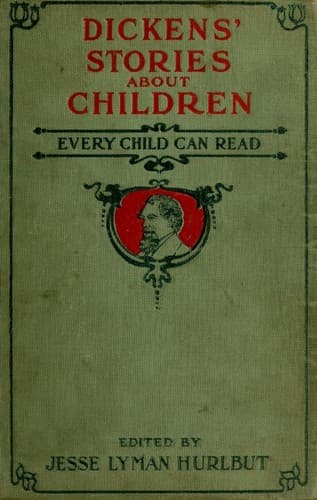
Dickens' Stories About Children Every Child Can Read — John Shaqi
Dickens' Stories About Children Every Child Can ReadDickens, Charles
General
Dickens' Stories About Children Every Child Can Read
Dickens, Charles
Children -- Juvenile fiction; Children's stories, English
I am saying that Caleb and his blind daughter lived here. I should say
Caleb did, while his daughter lived in an enchanted palace, which her
father's love had created for her. She did not know that the ceilings
were cracked, the plaster tumbling down, and the woodwork rotten; that
everything was old and ugly and poverty-stricken about her, and that her
father was a gray-haired, stooping old man, and the master for whom they
worked a hard and brutal taskmaster; oh, dear no, she fancied a pretty,
cosy, compact little home full of tokens of a kind master's care, a
smart, brisk, gallant-looking father, and a handsome and noble-looking
toy merchant who was an angel of goodness.
This was all Caleb's doing. When his blind daughter was a baby he had
determined, in his great love and pity for her, that her loss of sight
should be turned into a blessing, and her life as happy as he could make
it. And she was happy; everything about her she saw with her father's
eyes, in the rainbow-colored light with which it was his care and
pleasure to invest it.
Caleb and his daughter were at work together in their usual
working-room, which served them for their ordinary living-room as well;
and a strange place it was. There were houses in it, finished and
unfinished, for dolls of all stations in life. Tenement houses for dolls
of moderate means; kitchens and single apartments for dolls of the lower
classes; capital town residences for dolls of high estate. Some of these
establishments were already furnished with a view to the needs of dolls
of little money; others could be fitted on the most expensive scale, at
a moment's notice, from whole shelves of chairs and tables, sofas,
bedsteads, and upholstery. The nobility and gentry and public in
general, for whose use these doll-houses were planned, lay, here and
there, in baskets, staring straight up at the ceiling; but in showing
their degrees in society, and keeping them in their own stations (which
is found to be exceedingly difficult in real life), the makers of these
dolls had far improved on nature, for they, not resting on such marks as
satin, cotton-print, and bits of rag, had made differences which allowed
of no mistake. Thus, the doll-lady of high rank had wax limbs of perfect
shape; but only she and those of her grade; the next grade in the social
scale being made of leather; and the next coarse linen stuff. As to the
common-people, they had just so many matches out of tinder-boxes for
their arms and legs, and there they were--established in their place at
once, beyond the possibility of getting out of it.
Public-domain text, read in full here on John Shaqi.
Reviews
Reviews
No reviews yet
Be the first to share your thoughts on this work.
Join the Discussion
Join the discussion
Sign in to leave a comment or review.
Sign InorCreate an account