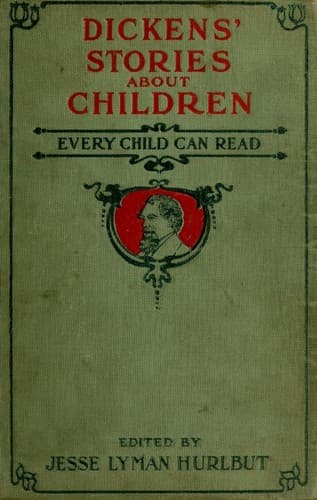
Dickens' Stories About Children Every Child Can ReadDickens, Charles
General
Dickens' Stories About Children Every Child Can Read
Dickens, Charles
Children -- Juvenile fiction; Children's stories, English
That night they reached a little village in a woody hollow. The village
schoolmaster, a good and gentle man, pitying their weariness, and
attracted by the child's sweetness and modesty, gave them a lodging for
the night; nor would he let them leave him until two days more had
passed.
They journeyed on, when the time came that they must wander forth again,
by pleasant country lanes; and as they passed, watching the birds that
perched and twittered in the branches overhead, or listening to the
songs that broke the happy silence, their hearts were peaceful and free
from care. But by-and-by they came to a long winding road which
lengthened out far into the distance, and though they still kept on, it
was at a much slower pace, for they were now very weary.
The afternoon had worn away into a beautiful evening, when they arrived
at a point where the road made a sharp turn and struck across a common.
On the border of this common, and close to the hedge which divided it
from the cultivated fields, a caravan was drawn up to rest; upon which
they came so suddenly that they could not have avoided it if they would.
Do you know what a "caravan" is? It is a sort of gipsy house on wheels
in which people live, while the house moves from place to place.
It was not a shabby, dingy, dusty cart, but a smart little house with
white dimity curtains hung over the windows, and window-shutters of
green picked out with panels of a staring red, in which
happily-contrasted colors the whole house shone brilliant. Neither was
it a poor caravan drawn by a single donkey or feeble old horse, for a
pair of horses in pretty good condition were released from the shafts
and grazing on the frouzy grass. Neither was it a gipsy caravan, for at
the open door (graced with a bright brass knocker) sat a Christian lady,
stout and comfortable to look upon, who wore a large bonnet trembling
with bows. And that it was not a caravan of poor people was clear from
what this lady was doing; for she was taking her tea. The tea-things,
including a bottle of rather suspicious looks and a cold knuckle of ham,
were set forth upon a drum, covered with a white napkin; and there, as
if at the most convenient round-table in all the world, sat this roving
lady, taking her tea and enjoying the prospect.
It happened at that moment that the lady of the caravan had her cup
(which, that everything about her might be of a stout and comfortable
kind, was a breakfast cup) to her lips, and that having her eyes lifted
to the sky in her enjoyment of the full flavor of her tea, it happened
that, being thus agreeably engaged, she did not see the travelers when
they first came up. It was not until she was in the act of setting down
the cup, and drawing a long breath after the exertion of swallowing its
contents, that the lady of the caravan beheld an old man and a young
child walking slowly by, and glancing at her proceedings with eyes of
modest, but hungry admiration.
Public-domain text, read in full here on John Shaqi.
Reviews
Reviews
No reviews yet
Be the first to share your thoughts on this work.
Join the Discussion
Join the discussion
Sign in to leave a comment or review.
Sign InorCreate an account