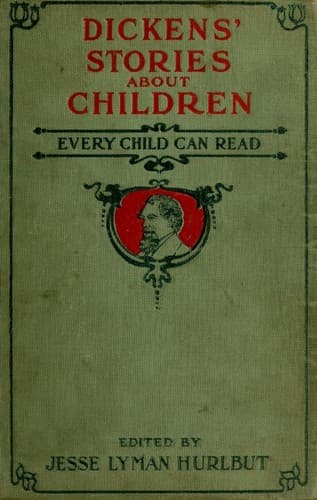
Dickens' Stories About Children Every Child Can ReadDickens, Charles
General
Dickens' Stories About Children Every Child Can Read
Dickens, Charles
Children -- Juvenile fiction; Children's stories, English
It was not an easy matter to come up with him and ask his aid, for he
walked fast, and was a little distance in advance. At length he stopped,
to look more attentively at some passage in his book. Encouraged by a
ray of hope, the child shot on before her grandfather, and, going close
to the stranger without rousing him by the sound of her footsteps,
began, in a few faint words, to beg his help.
He turned his head. The child clapped her hands together, uttered a wild
shriek, and fell senseless at his feet.
It was the poor schoolmaster. No other than the poor schoolmaster.
Scarcely less moved and surprised by the sight of the child than she had
been on recognizing him, he stood, for a moment, silent, without even
the presence of mind to raise her from the ground.
But, quickly recovering himself, he threw down his stick and book, and,
dropping on one knee beside her, tried simple means as came to his mind,
to restore her to herself; while her grandfather, standing idly by,
wrung his hands, and begged her, with many words of love, to speak to
him, were it only a whisper.
"She appears to be quite worn out," said the schoolmaster, glancing
upward into his face. "You have used up all her strength, friend."
"She is dying of want," answered the old man. "I never thought how weak
and ill she was till now."
Casting a look upon him, half-angry and half-pitiful, the schoolmaster
took the child in his arms, and, bidding the old man gather up her
little basket and follow him directly, bore her away at his utmost
speed.
There was a small inn within sight, to which, it would seem, he had been
walking when so unexpectedly overtaken. Toward this place he hurried
with his unconscious burden, and rushing into the kitchen, and calling
upon the company there assembled to make way for God's sake, laid it
down on a chair before the fire.
The company, who rose in confusion on the schoolmaster's entrance, did
as people usually do under such circumstances. Everybody called for his
or her favorite remedy, which nobody brought; each cried for more air,
at the same time carefully shutting out what air there was, by closing
round the object of sympathy; and all wondered why somebody else didn't
do what it never appeared to occur to them might be done by themselves.
Public-domain text, read in full here on John Shaqi.
Reviews
Reviews
No reviews yet
Be the first to share your thoughts on this work.
Join the Discussion
Join the discussion
Sign in to leave a comment or review.
Sign InorCreate an account