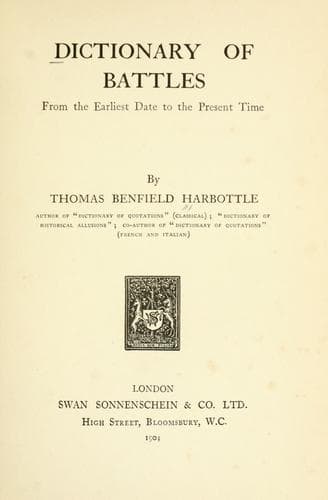
Dictionary of Battles: From the Earliest Date to the Present TimeHarbottle, Thomas Benfield
History
Dictionary of Battles: From the Earliest Date to the Present Time
Harbottle, Thomas Benfield
Battles
General Buller’s second attempt to break through the Boer lines on the
Tugela, and relieve Ladysmith, is known by this name. The operations
commenced on the 19th, 24,000 men being employed. On that day Sir
Charles Warren’s division commenced to turn the Boer right, and
gradually drove them from ridge to ridge till the evening of the 22nd,
when by a night surprise, Spion Kop, the centre of the position, was
seized. It was, however, found impossible to get artillery up the steep
slopes, and the brigade holding the hill lost about a third of their
strength in the course of the 23rd, including the Brigadier, General
Woodgate. At nightfall, Colonel Thorneycroft, who had been appointed to
the command, abandoned the hill, and on the following day General Buller
decided to recross the Tugela. The British losses during the operations
amounted to 87 officers and 1,647 men.
Spira (War of the Spanish Succession).
Fought November 15, 1703, between the French, under Marshal Tallard, and
the Imperialists, under the Prince of Hesse, each side being about
20,000 strong. After a severe engagement, the Imperialists were
overpowered by the French cavalry, and totally defeated with a loss of
6,000 killed, wounded and missing. Among the prisoners was the Prince of
Hesse.
Splitter (Swedish Invasion of Brandenburg).
Fought January, 1679, between 16,000 Swedes, under Field-Marshal Horn,
and 10,000 Brandenburgers, under the Elector Frederick William. The
Swedes were utterly routed, Horn being taken prisoner, and not more than
1,500 succeeded in making their way to Riga.
Spottsylvania (American Civil War).
A continuation of the Battle of the Wilderness, fought May 10 to 12,
1864, between the Confederates, under General Lee, and the Federals,
under General Grant. Lee’s position covering Richmond was attacked on
the 10th by Grant, and the day ended with both armies in their original
positions, while the losses, especially on the side of the assailants,
were very heavy. On the 12th Grant renewed the attack, and General
Hancock, on the right surprised the first line of the Confederate
defences, and compelled General Johnson and his division to surrender.
With this exception, entailing the loss of about a mile of ground Lee
held his own throughout the day, and Grant had suffered too severely to
renew the attack. The losses from the 5th, the date of the first Battle
of the Wilderness, to the 12th inclusive, were: Federals, about 50,000
killed and wounded, Confederates, about 12,000.
Spurs.
_See_ Courtrai.
Spurs.
_See_ Guinegate.
Stadtlohn (Thirty Years’ War).
Fought August 9, 1623, between the army of the Protestant Princes of
Germany, about 22,000 strong, under Duke Christian of Brunswick and the
Imperialists, under Tilly. The Protestants were utterly routed and
dispersed, Christian fleeing to Holland.
Public-domain text, read in full here on John Shaqi.
Reviews
Reviews
No reviews yet
Be the first to share your thoughts on this work.
Elsewhere in the archive
Join the Discussion
Join the discussion
Sign in to leave a comment or review.
Sign InorCreate an account