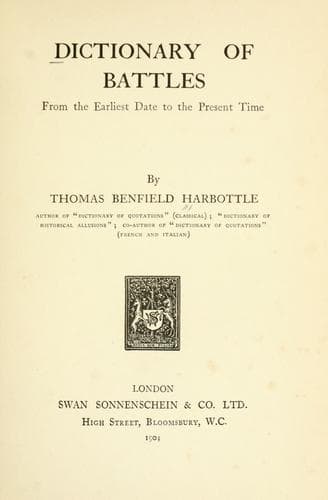
Dictionary of Battles: From the Earliest Date to the Present TimeHarbottle, Thomas Benfield
History
Dictionary of Battles: From the Earliest Date to the Present Time
Harbottle, Thomas Benfield
Battles
Staffarda (War of the Revolution).
Fought 1690, between the French, under Marshal Catinat, and the
Imperialists, under Victor Amadeus of Savoy. The Imperialists met with a
crushing defeat.
Stamford Bridge.
Fought September 25, 1066, between the English, under Harold, and the
Norse invaders, under Harold Hardrada and Tostig. The Norsemen were
surprised by Harold in their camp, and totally defeated, both Hardrada
and Tostig being killed, and the survivors driven to their ships.
Stamford Bridge (Wars of the Roses).
An encounter between the retainers of Sir Thomas Neville, and those of
Lord Egremont, which developed into a pitched battle, in August, 1453.
It is considered to be the beginning of the Wars of the Roses.
Standard, The (Scottish Wars).
Fought at Luton Moor, near Northallerton, in 1138, between the Scots,
under David, and the English, under Thurstan, Archbishop of York, and
Raoul, Bishop of Durham. The Scots were routed, and fled in disorder.
The battle derives its name from the fact that the banner of St.
Cuthbert of Durham, which was held to ensure victory, that of St. Peter
of York, and those of other saints, were carried in a waggon in the
midst of the English army.
Stavrichani (Ottoman Wars).
Fought August 28, 1739, between 30,000 Russians, under General Münnich,
and the Turkish army, under Veli Pasha. The Russians stormed the Turkish
entrenched camp, driving the Turks headlong into the Danube, where
thousands perished, and capturing all their guns and baggage. Münnich
followed up this success by the capture of Choczin.
Steinkirk (War of the Revolution).
Fought August 8, 1692, between the English, under William III, and the
French, under Marshal Luxembourg. The English attacked the French camp
at daybreak, and broke and dispersed a brigade. Luxembourg, however,
rallied his troops, and after a severe engagement, repulsed the English
attack, though William was able to withdraw his forces in good order.
Stillwater (American War of Independence).
Fought October 7, 1777, between the British, 6,000 strong, under General
Burgoyne, and the Americans, under General Gates. The Americans occupied
a strongly entrenched position, which was attacked by Burgoyne. After a
severe encounter, the attack was repulsed at all points, and the British
driven back upon their camp at Saratoga, with heavy loss, including
General Fraser, mortally wounded. The Americans followed up their
success by an assault upon the British camp, in which they succeeded in
effecting a lodgement, and on the following day, Burgoyne withdrew, and
took up a fresh position on the heights near the Hudson. On October 15,
Burgoyne, surrounded by the Americans, and finding that no aid could
reach him, surrendered with 5,790 men, his total losses during the
campaign having amounted to 4,689.
Public-domain text, read in full here on John Shaqi.
Reviews
Reviews
No reviews yet
Be the first to share your thoughts on this work.
Elsewhere in the archive
Join the Discussion
Join the discussion
Sign in to leave a comment or review.
Sign InorCreate an account