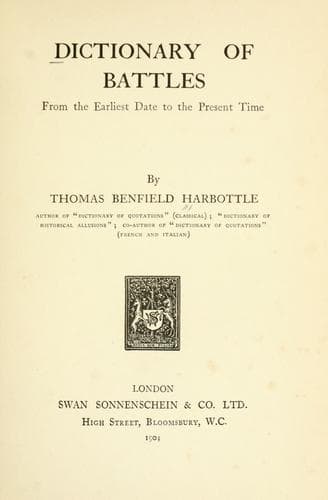
Dictionary of Battles: From the Earliest Date to the Present TimeHarbottle, Thomas Benfield
History
Dictionary of Battles: From the Earliest Date to the Present Time
Harbottle, Thomas Benfield
Battles
Fought October 25, 1854, between 30,000 Russians under Prince
Mentschikoff, and the British under Lord Raglan. The Russians, having
driven the Turks from their redoubts at Kadikoi, entered the valley of
Balaclava, where they were encountered and driven back by the Heavy
Cavalry Brigade under General Scarlett. Later in the day, acting under a
mistaken order, Lord Cardigan at the head of the Light Brigade, charged
the Russian guns at the head of the valley, and captured their
batteries. Being, however, shelled from all sides, he was compelled to
retire with heavy loss. Of this famous feat of arms, General Pelissier
is reported to have said, “C’est magnifique, mais ce n’est pas la
guerre.” Another feature of this singular battle was the repulse by the
Highland Brigade, in line, of a charge of the Russian cavalry. The
British losses were small, except in the case of the Light Brigade,
whose casualties amounted to 272 out of 673 who took part in the charge.
Balls Bluff (American Civil War).
Fought October 21, 1861, between the Federals under General Stone, and
the Confederates under General Evans. The Federals crossed the Potomac
to attack the Southern position, but were repulsed, and driven back over
the river in confusion losing 1,100 killed and wounded, 700 prisoners
and the only three guns which they had succeeded in taking across. The
Confederates lost 155 only.
Ballymore (Irish Rebellion).
Fought June 3, 1798, when Colonel Walpole, with 500 Royal troops, on the
march to Enniscorthy, was surprised and overpowered by a body of rebels
under Father Murphy. Walpole and the majority of his force were cut to
pieces.
Baltimore (Second American War).
This city was attacked September 11, 1814, by a British fleet of ten
sail, under Admiral Sir Alexander Cochrane, and a land force of 3,270
under General Ross, who fell during the action. The Americans, 17,000
strong, under General Winder, were defeated, but the British retired on
the evening of the 13th. The British lost 46 killed and 300 wounded, the
Americans, 20 killed, 90 wounded, and 200 prisoners.
Bamian (Tartar Invasion of Kharismia).
This city was invested by the Mongols under Genghiz Khan in 1221, and
after an obstinate defence, lasting several months, was taken by storm.
Genghiz, who had seen a favourite grandson killed during the progress of
the siege, gave orders that neither woman nor child was to be spared,
and the whole city with its inhabitants was wiped out.
Banda (Indian Mutiny).
Fought April 19, 1858, between a force of rather over 1,000 British
troops under General Whitlock, and 7,000 mutineers under the Nawab of
Banda. After an obstinate conflict the rebels were totally routed.
Banda Islands (Wars of the French Revolution).
Public-domain text, read in full here on John Shaqi.
Reviews
Reviews
No reviews yet
Be the first to share your thoughts on this work.
Join the Discussion
Join the discussion
Sign in to leave a comment or review.
Sign InorCreate an account