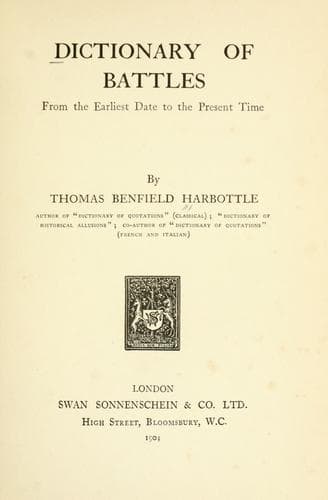
Dictionary of Battles: From the Earliest Date to the Present Time — John Shaqi
Dictionary of Battles: From the Earliest Date to the Present TimeHarbottle, Thomas Benfield
History
Dictionary of Battles: From the Earliest Date to the Present Time
Harbottle, Thomas Benfield
Battles
Siege was laid to this city by the Christians in August, 1189, and it
was obstinately defended by the Saracens for two years, during which the
Crusaders are said to have lost 120,000 men. In June, 1191, the
besiegers were reinforced by an English army under Richard Cœur de
Lion, and in the following month the garrison surrendered.
Acre.
The city remained in the hands of the Christians till 1291, when it was
captured by the Moslems under Malek al Aschraf, Sultan of Egypt. The
last stronghold in the Holy Land thus passed out of the keeping of the
Christians.
Acre (French Invasion of Egypt).
The city was besieged March 17, 1799, by the French under Napoleon, and
defended by the Turks under Djezzar, and a small force of British seamen
under Sir Sidney Smith. An assault on the 28th was repulsed with loss,
and then a threatened attack by a Syrian army forced Napoleon to
withdraw a large portion of his troops. On the resumption of the siege,
no less than seven more assaults were delivered, while the French had to
meet eleven sallies of the besieged, but they were unable to effect a
lodgment, and on May 21 Napoleon reluctantly raised the siege. The fall
of Acre would have placed the whole of Syria, and possibly of the
Turkish Empire, in the hands of the French.
Acre (Mehemet Ali’s Second Rebellion).
Mehemet Ali having refused to accept the conditions imposed upon him by
the Quadrilateral Alliance, Acre was bombarded, November 3, 1840, by a
combined British and Turkish fleet under Sir R. Stopford, and the town
laid in ruins.
Acs (Hungarian Rising).
Fought July 2, 1849, between 25,000 Hungarians, under Görgey, and the
Russo-Austrian army, greatly superior in numbers, under Prince
Windischgrätz. The allies attacked the entrenched camp of the
Hungarians, outside Komorn, while the Hungarians made an attempt to turn
the allied left. Both attacks were repulsed, and the battle was
undecided.
Actium (Mark Antony’s Second Rebellion).
Fought September 2, B.C. 31, between the fleet of Antony, 460 galleys,
and that of Octavius, about 250 sail, but much lighter and less well
manned than those of Antony. The battle was fiercely contested, with
varying fortune; but at a critical moment Cleopatra ordered the Egyptian
admiral to make sail, and with 60 galleys withdrew from the fight. She
was followed by Antony, and his fleet, discouraged by his flight,
surrendered after ten hours’ fighting. The Octavians captured 300
galleys, and 5,000 Antonians fell in the action. A few days later
Antony’s land army of 120,000 men laid down their arms.
Acultzingo (Franco-Mexican War).
Public-domain text, read in full here on John Shaqi.
Reviews
Reviews
No reviews yet
Be the first to share your thoughts on this work.
Join the Discussion
Join the discussion
Sign in to leave a comment or review.
Sign InorCreate an account