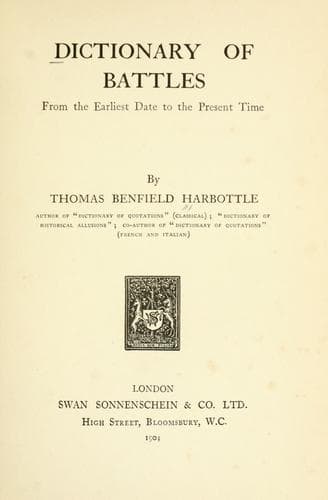
Dictionary of Battles: From the Earliest Date to the Present TimeHarbottle, Thomas Benfield
History
Dictionary of Battles: From the Earliest Date to the Present Time
Harbottle, Thomas Benfield
Battles
Fought 1398, between the Mongols under Tamerlane, and the Delhi
Mohammedans under Mahmud Tughlak. Tamerlane, having crossed the Jumna to
reconnoitre with an escort of 700 horsemen, was attacked by Mahmud with
5,000 cavalry. Tamerlane repulsed the attack, and later, having brought
his main body across the river, totally defeated Mahmud, and drove him
into Delhi, which at once surrendered. The city was plundered, and
Tamerlane withdrew laden with spoil.
Delhi (Second Mahratta War).
Fought September 11, 1803, between 4,500 British under General Lake, and
19,000 Mahrattas of Scindiah’s army under Bourquin. The enemy occupied a
strong position with the Jumna in their rear, and Lake, feigning a
retreat, drew them from their lines, and then turning upon them drove
them with the bayonet into the river, inflicting enormous loss upon
them. The British lost 400 only.
Delhi (Second Mahratta War).
The city was invested October 7, 1804, by 20,000 Mahrattas, with 100
guns, under Jeswunt Rao Holkar, and was successfully defended for nine
days by a small British garrison. At the end of this period, Holkar
withdrew. So small was the garrison, that they were on constant duty on
the ramparts, throughout the siege, without relief.
Delhi (Indian Mutiny).
After the outbreak at Meerut, Delhi became the rallying place of the
mutineers, and on June 8, 1857, Sir Harry Barnard commenced the siege of
the city. His force was too small for a complete investment, while the
mutineers numbered 30,000, and could obtain continual reinforcements,
and ample supplies. The garrison made constant sorties, and fighting was
incessant at the outposts. On September 8 the breaching batteries opened
fire, and on the 14th the final assault was made and the city entered.
It was not, however, till the 20th that the Palace was taken, and all
resistance at an end. Among those who fell was John Nicholson.
Delium (Peloponnesian War).
Fought B.C. 424 between the Athenians under Hippocrates. 17,000 strong,
and the Bœotians under Pagondas, 18,000 strong. The armies met on a
plain before Delium, and after an obstinate encounter, in which the
Thebans on the right overpowered the Athenians, while their left attack
was repulsed, the appearance of a large body of cavalry on their flank
alarmed the Athenians, who broke and fled, Hippocrates fell in the
battle.
Delphi (Sacred War).
Fought B.C. 355, between the Phocians, 5,000 strong, under Philomelus,
and the Locrians. Philomelus, who had seized Delphi, attacked the
Locrians on the heights above the sacred city, and routed them with
heavy loss, many being driven over the precipice.
Denain (War of the Spanish Succession).
Public-domain text, read in full here on John Shaqi.
Reviews
Reviews
No reviews yet
Be the first to share your thoughts on this work.
Elsewhere in the archive
Join the Discussion
Join the discussion
Sign in to leave a comment or review.
Sign InorCreate an account