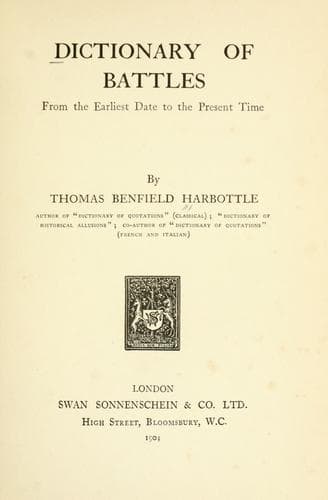
Dictionary of Battles: From the Earliest Date to the Present TimeHarbottle, Thomas Benfield
History
Dictionary of Battles: From the Earliest Date to the Present Time
Harbottle, Thomas Benfield
Battles
Fought 1712, when the camp of the allies, held by 10 battalions under
the Earl of Albemarle, was attacked by 130 French battalions under
Marshal Villiers. Prince Eugene made an effort to relieve the Earl, but
was unable to cross the Scheldt, and the allies were overwhelmed by
superior numbers, only about 4,000 making good their retreat. Five
generals were killed or captured.
Dennewitz (Campaign of Leipsic).
Fought September 6, 1813, between the French army of the north under
Ney, and the allies under the Crown Prince of Sweden. Ney had detached
Bertrand’s division to mask Dennewitz, while his main body marched past
the position on the road to Berlin, but Bertrand delayed so long before
Dennewitz, that what was intended for a demonstration became a serious
action, in which the full force of both sides was engaged. The French
were defeated with a loss of 10,000 men and 43 guns.
Deorham.
Fought 577, when Ceawlin, King of Wessex, defeated the Welsh, and
extended the borders of Wessex to the Bristol Channel, thus severing the
Welsh nation into two parts.
Dessau (Thirty Years’ War).
Fought April 15, 1626, between the German Protestants under Count von
Mansfeldt, and the Imperialists, about 20,000 strong, under Wallenstein.
Mansfeldt was attacking the fort of Dessau, on the Elbe, when
Wallenstein, approaching under cover of the woods, fell upon his flank,
and totally routed him, killing or capturing nearly three-fourths of his
army.
Dettingen (War of the Austrian Succession).
Fought June 27, 1743, between the British, 40,000 strong, under George
II, and 60,000 French under the Duc de Noailles. The British, who were
retiring upon Hanau from Aschaffenburg, found their retreat cut off by
the French, Dettingen being held by 23,000 men under de Grammont, while
the main body was on the opposite bank of the Maine. De Grammont left
his lines to attack the British, whereupon George II put himself at the
head of his troops, and led a charge which broke the French and drove
them headlong into the river. Their losses in crossing were heavy, and
they left 6,000 killed and wounded on the field. This is the last
occasion on which the Sovereign has led British troops in battle.
Deutschbrod (Hussite War).
Fought 1422 between the Taborite section of the Hussites under John
Zisca, and the Germans under the Emperor Sigismund. Zisca was completely
victorious.
Devicotta.
This fortress, held for Pertab Singh by a garrison of the Tanjore army,
was captured in 1749, after a three days’ bombardment, by a British
force of 2,300 men under Major Lawrence. An attack upon the breach,
headed by Clive, was nearly disastrous, as the Sepoys hung back, and of
the Europeans engaged, only Clive and three others escaped, but Lawrence
arriving opportunely with the main column, the place was stormed.
Public-domain text, read in full here on John Shaqi.
Reviews
Reviews
No reviews yet
Be the first to share your thoughts on this work.
Elsewhere in the archive
Join the Discussion
Join the discussion
Sign in to leave a comment or review.
Sign InorCreate an account