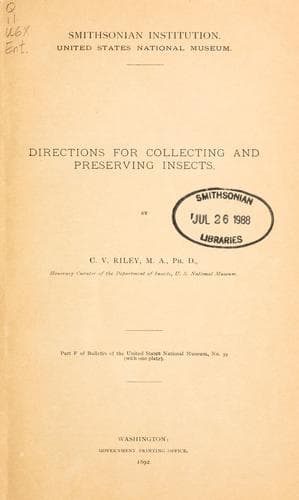
Directions for Collecting and Preserving InsectsRiley, Charles V. (Charles Valentine)
Science
Directions for Collecting and Preserving Insects
Riley, Charles V. (Charles Valentine)
Insects -- Collection and preservation
"There are one or two points which should be remembered when obtaining
eggs and rearing larvae. In the first place, the females should not be
left exposed to the direct rays of the sun; but it will be found
sometimes that if a butterfly is sluggish, putting her in the sun for a
short time will revive her and make her lay eggs. Confined females,
whether over branches or potted plants, should always be in the open
air. If females do not lay in two or three days they must be fed. This
is easily done. Take them from the cage and hold near them a piece of
sponge (or, Mr. Edwards suggests, evaporated apple), saturated with a
weak solution of sugar and water. As soon as it is placed near them they
will generally move their antennae towards it, and, uncoiling their
tongues, suck up the liquid. If they take no notice of it the tongue can
be gently uncoiled with the tip of a pin, when they will nearly always
begin to feed. It is better to feed them away from the plant they are
wanted to lay upon, for if any of the sirup be spilled over the
flowerpot or plant it is almost sure to attract ants. I kept one female
_Colias interior_ in this way for ten days before eggs were laid. When
eggs are laid they should, as a rule, be collected at short intervals.
They are subject to the attacks of various enemies--spiders, ants,
crickets, and minute hymenopterous parasites. They may be kept easily in
small boxes, but do better if not kept in too hot or dry a place. When
the young caterpillars hatch they must be removed with great care to the
food plant; a fine paint brush is the most convenient instrument. With
small larvae or those which it is desired to examine often, glass tubes
or jelly glasses with a tight-fitting tin cover are best. These must be
tightly closed and in a cool place. Light is not at all necessary, and
the sun should never be allowed to shine directly upon them. If
moisture gathers inside the glasses the top should be removed for a
short time. Larvae may also be placed upon growing plants. These can be
planted in flowerpots and the young caterpillars kept from wandering
either by a cage of wire netting or, by what I have found very
satisfactory, glass lamp chimneys. These can be placed over the plant,
with the bottom pushed into the earth, and then should have a loose wad
of cotton batting in the top. This has the double effect of preventing
too great evaporation of moisture and keeping its occupants within
bounds. Some larvae wander very much and climb with the greatest ease
over glass, spinning a silken path for themselves as they go. When
caterpillars are bred in the study it must not be forgotten that the air
inside a house is much drier than it is out of doors amongst the trees
and low herbage, where caterpillars live naturally. The amateur will
require some experience in keeping the air at a right degree of moisture
when breeding upon growing plants. In close tin boxes or jars, where the
Public-domain text, read in full here on John Shaqi.
Reviews
Reviews
No reviews yet
Be the first to share your thoughts on this work.
Elsewhere in the archive
Join the Discussion
Join the discussion
Sign in to leave a comment or review.
Sign InorCreate an account