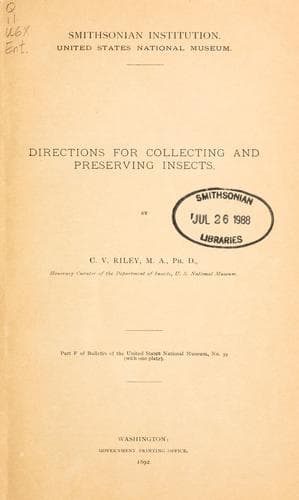
Directions for Collecting and Preserving InsectsRiley, Charles V. (Charles Valentine)
Science
Directions for Collecting and Preserving Insects
Riley, Charles V. (Charles Valentine)
Insects -- Collection and preservation
leaves must be changed every day, there is not so much trouble. An
important thing to remember with larvae in jars is to thoroughly wash out
the jars with cold water every day. If, however, a caterpillar has spun
a web on the side and is hung up to moult, it must not be disturbed. In
changing the food it is better not to remove the caterpillars from the
old food, but having placed a new supply in the jar, cut off the piece
of leaf upon which they are and drop it into the jar. If they are not
near the moult a little puff of breath will generally dislodge them.
Some caterpillars, as _Papilio turnus_, which spins a platform to which
it retires after feeding, can best be fed upon a living tree out of
doors, but must be covered with a gauze bag to keep off enemies. A piece
of paper should be kept _attached_ to each breeding jar or cage, upon
which regular notes must be taken _at the time_, giving the dates of
every noticeable feature, particularly the dates of the moults and the
changes which take place in the form and color at that time."
The necessity of outdoor work is further felt in the determination of
the facts in the life-history of some insects which have an alternation
of generations, as some Gall-flies (_Cynipidae_), and most Aphides. To
successfully study these insects constant outdoor observation is
necessary, or the species must be inclosed in screens of wire or netting
outdoors on their food-plant. Many insects which breed on the ground or
on low herbage may be very successfully watched and controlled by
covering the soil containing them or the plant on which they feed with a
wire screen or netting. The use of wire screens is also advisable in the
case of wintering pupae or larvae out of doors. Many species can be more
easily carried through the winter by placing them outdoors under such
screens during the winter, which insures their being subjected to the
natural conditions of climate, and then transferring them to the
breeding cage again early in the spring. This is advisable in the case
of Microlarvae and pupae. Species which bore in the stems of plants may be
easily cared for and leaf-mining and leaf-webbing forms can be secured
under screens or covers out of doors for the winter in sheltered
situations. Many species which, if kept in a warm room can not be
reared, will, if subjected to freezing weather under slight protection
in the open air, emerge successfully the following spring.
Public-domain text, read in full here on John Shaqi.
Reviews
Reviews
No reviews yet
Be the first to share your thoughts on this work.
Elsewhere in the archive
Join the Discussion
Join the discussion
Sign in to leave a comment or review.
Sign InorCreate an account