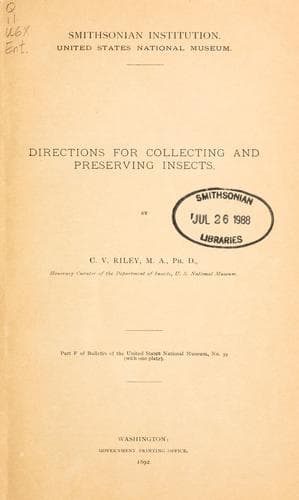
Directions for Collecting and Preserving InsectsRiley, Charles V. (Charles Valentine)
Science
Directions for Collecting and Preserving Insects
Riley, Charles V. (Charles Valentine)
Insects -- Collection and preservation
"Suborder APHANIPTERA ([Greek: aphanes], inconspicuous; [Greek: pteron],
wing) or Fleas, comprising the single family Pulicidae, now placed with
the Diptera. Everybody is supposed to be familiar with the appearance of
the Flea--its bloodthirsty propensities and amazing muscular power; and
while everyone may not have the leisure and means to experience the
exhilarating influence of the chase after larger animals, there is no
one--be he never so humble--who may not indulge in the hunt after this
smaller game! In place of wings the flea has four small, scaly plates.
The minute eggs--about a dozen to each female--are laid in obscure
places, such as the cracks of a floor, the hair of rugs, etc., and the
larva is worm-like and feeds upon whatever animal matter--as grease and
blood--or decaying vegetable matter it can find.
"Order ORTHOPTERA ([Greek: orthos], straight; [Greek: pteron], wing), or
Straight-winged Insects. Characterized by having the front wings (called
_tegmina_) straight and usually narrow, pergameneous or parchment-like,
thickly veined, and overlapping at tips when closed; the hind wings
large and folding longitudinally like a fan. Transformations incomplete.
[Illustration: FIG. 28.--A Locust (_Acridium americanum_).]
[Illustration: FIG. 29.--A Tree-cricket (_Orocharis saltator_). _a_,
female; _b_, male.]
[Illustration: FIG. 30.--The Croton Bug or German Cockroach
(_Phyllodromia germanica_). _a_, first stage; _b_, second stage; _c_,
third stage; _d_, fourth stage; _e_, adult; _f_, adult female with
egg-case; _g_, egg-case--enlarged; _h_, adult with wings spread--all
natural size except _g_.]
"The insects of this order have a lengthened body and very robust jaws,
with a correspondingly large head. The legs are strong, and fashioned
either for grasping, running, climbing, jumping, or burrowing. As in the
other orders, where the transformations are incomplete, the young differ
little from the parent, except in the want of wings; and in many
instances even this difference does not exist, as there are numerous
species which never acquire wings. There are no aquatic Orthoptera. Some
are omnivorous, others carnivorous, but most of them herbivorous. They
form four distinct sections: 1st, CURSORIA, Cockroaches; 2d, RAPTATORIA,
Mantes; 3d, AMBULATORIA, Walking-sticks; 4th, SALTATORIA, Crickets,
Grasshoppers, and Locusts.
[Illustration: FIG. 31.--Hind wing of Earwig. (From Comstock.)]
[Illustration: FIG. 32.--An Earwig. (From Packard.)]
Public-domain text, read in full here on John Shaqi.
Reviews
Reviews
No reviews yet
Be the first to share your thoughts on this work.
Join the Discussion
Join the discussion
Sign in to leave a comment or review.
Sign InorCreate an account