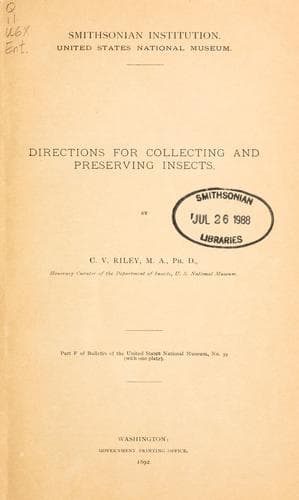
Directions for Collecting and Preserving InsectsRiley, Charles V. (Charles Valentine)
Science
Directions for Collecting and Preserving Insects
Riley, Charles V. (Charles Valentine)
Insects -- Collection and preservation
_The Haversack._--In order that the above-mentioned instruments and the
various bottles, vials, and boxes which are needed for the preservation
of specimens may most conveniently and with the least impediment to the
collector be carried along on excursions, a haversack is indispensable.
This is made either of leather or, still better, of some waterproof
cloth, and should contain various compartments of different sizes; one
for stowing away the nets, the sieve, and the larger instruments, and
several smaller ones for boxes and vials--the whole so arranged that
each desired object can readily be taken out and that nothing will drop
out and get lost. The haversack is slung across the shoulders by means
of a leather strap, and a full field outfit need not be very heavy nor
seriously interfere with free bodily movements.
Many of the smaller objects are most conveniently carried in the pockets
of the coat, which acquires, therefore, some importance to the
collector. The coat should be of some durable stuff and provided with
many pockets, so arranged that in stooping nothing falls out of them.
_The Lens and Microscope._--In the examination of the minuter forms of
insect life the naked eye is not sufficient, and a hand-lens, or, for
more delicate work, the compound microscope will be found necessary. I
had, in my early experience, some difficulty in getting a satisfactory
hand-lens, and the use of a poor hand-lens in time injures the eyesight,
as I know by a year's rather disagreeable experience. For a hand-lens
the achromatic lenses formerly manufactured by A. K. Eaton, of Brooklyn,
N. Y., and now made by John Green, 35 Liverpool street, East Boston,
Mass., are most excellent in workmanship and are satisfactory in every
respect. A very good lens can also be purchased of any of the leading
manufacturers of microscopical apparatus in this country. The kind of
compound microscope to be purchased will depend upon the nature of the
work of the investigator. Very serviceable instruments are made by J. W.
Queen & Co., Philadelphia, Pa., and by the Bausch & Lomb Optical
Company, of Rochester, N. Y., and others. The German microscopes are in
many respects superior to those of American make, and if one has
sufficient means, I would recommend the purchase of one of the better
instruments of Zeiss's manufacture, which may be obtained either direct
from the manufacturers or through Queen & Co., or from the Boston
Educational Supply Company. Microscopic material, including slides,
cover glasses, instruments for mounting, mounting media, staining
fluids, etc., may be obtained of either of the firms named above.
Having thus indicated somewhat fully the general methods of collecting,
and the paraphernalia most desirable in collecting, it will be well to
go still further into detail, and in connection with the different
orders give some more specific information that will be valuable as a
guide not only to the general collector, but to the specialist.
Public-domain text, read in full here on John Shaqi.
Reviews
Reviews
No reviews yet
Be the first to share your thoughts on this work.
Join the Discussion
Join the discussion
Sign in to leave a comment or review.
Sign InorCreate an account