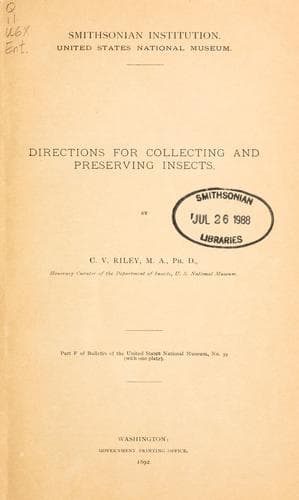
Directions for Collecting and Preserving Insects — John Shaqi
Directions for Collecting and Preserving InsectsRiley, Charles V. (Charles Valentine)
Science
Directions for Collecting and Preserving Insects
Riley, Charles V. (Charles Valentine)
Insects -- Collection and preservation
In this order the importance of collecting the early states and of
rearing the adult insects rather than of catching the latter should, if
the collector has the advancement of knowledge and the greatest pleasure
in mind, be insisted upon. Collected specimens, in the majority of
cases, will be more or less rubbed or damaged and unfit for permanent
keeping, and will always be far inferior to freshly reared specimens.
All Lepidopterists, therefore, rely to a great extent upon breeding
rather than upon field collecting. There are, however, many species of
which the early states are still unknown, and these can only be taken by
field collecting, and by attracting to various lights or traps. This
subject, therefore, naturally falls into two categories--(1) the general
collecting of the adult, and (2) collecting the early stages and rearing
the perfect insects.
[Illustration: FIG. 70.--The Eight-spotted Forester (_Alypia
octomaculata_). _a_, larva; _b_, enlarged segment of same; _c_, moth.]
_Collecting the Adult._--The implements for the general collecting of
butterflies comprise the collecting net, and in some cases the beating
net, although the use of the latter will not often be called for. The
Rhopalocera or Diurnals may be taken about flowers, and the best season
is in the early spring. Most of them are double-brooded, and the second
brood will be in the greatest abundance during July and August. They
are, however, to be found throughout the summer. They are also to be
looked for in the neighborhood of the food-plants of their larvae, and in
the case of many species, examination of such plants affords the most
satisfactory means of collecting. The food of butterflies is almost
exclusively the nectar of flowers, but strangely enough they are also
attracted to decaying animal matter, and many species, including rare
forms, may be taken about decaying animal matter or resting on spots
where dead animals have lain, or beneath which they have been buried.
Moist spots of earth are also frequented by them, especially in dry
seasons. Many of the larger butterflies, whose larvae feed on the taller
shrubs and the foliage of trees, will be found fluttering about the open
spaces in forests, but by far the larger number, as the Browns, the
Blues, the Yellows, and the Whites, which develop on the lower
herbaceous and succulent plants, will be found flying over fields,
prairies, and gardens. Crepuscular and nocturnal Lepidoptera, comprising
most of the Heterocera, the Sphingidae, Bombycids, Noctuids, etc., have
different habits. The Sphingidae or Hawk Moths fly in early evening, and
may be collected in quantity about such plants as the Honeysuckle,
Thistle, Verbena, Petunia, etc. The Bombycids and many Noctuids also fly
in the early evening, but mostly at night. The former, however, do not
frequent flowers, except such as are the food-plants of their larvae, as
their mouth-parts are rudimentary, and they take no nourishment.
Public-domain text, read in full here on John Shaqi.
Reviews
Reviews
No reviews yet
Be the first to share your thoughts on this work.
Join the Discussion
Join the discussion
Sign in to leave a comment or review.
Sign InorCreate an account