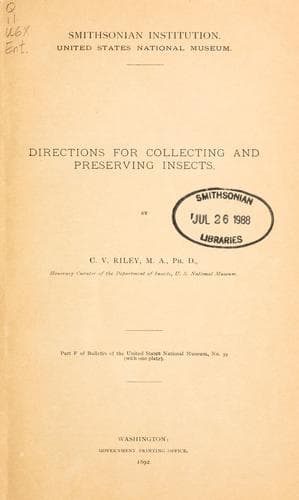
Directions for Collecting and Preserving InsectsRiley, Charles V. (Charles Valentine)
Science
Directions for Collecting and Preserving Insects
Riley, Charles V. (Charles Valentine)
Insects -- Collection and preservation
It will serve to make these instructions clear if I at once explain that
the life of an insect is marked by four distinct states, viz., the egg,
the larva, the pupa, and the imago, and that the last three words will
constantly recur. We have no English equivalent for the words larva and
pupa, for while some authors have written them with the terminal _e_, so
as to get the English plural, yet "larves" and "pupes" so shock the ear
that the terms have not been (and deserve not to be) generally adopted.
We have seen that an insect in the final state has six true legs. Yet
even here many species depart from the rule, as there are many in which
the perfect insect, especially in the female sex, is apodous or without
legs, just as there are also other cases where they are without wings.
Sometimes the legs seem to be reduced in number by the partial or total
atrophy of one or the other pair, but in all these exceptional cases
there is no difficulty in realizing that we have to deal with a true
insect, because of the other characters pertaining to the class, some of
which it will be well to allude to.
Insects are further characterized by having usually three distinct
divisions of the body, viz.: head, thorax, and abdomen, and by
undergoing certain metamorphoses or transformations. Now, while a number
of other animals outside of the insect world go through similar
transformations, those in the Crustacea being equally remarkable, yet,
from the ease with which they are observed and the completeness of the
transformations in most insects, the metamorphoses of this class have,
from time immemorial, excited the greatest curiosity.
SCOPE AND IMPORTANCE OF ENTOMOLOGY.
But few words are necessary to indicate the importance of entomology,
especially to the farming community; for while insects play a most
important part in the economy of nature and furnish us some valuable
products and otherwise do us a great deal of indirect good, yet they are
chiefly known by the annoyances they cause and by the great injury they
do to our crops and domestic animals. Hence some knowledge of insects
and how to study them becomes important, almost necessary, to every
farmer.
Public-domain text, read in full here on John Shaqi.
Reviews
Reviews
No reviews yet
Be the first to share your thoughts on this work.
Join the Discussion
Join the discussion
Sign in to leave a comment or review.
Sign InorCreate an account