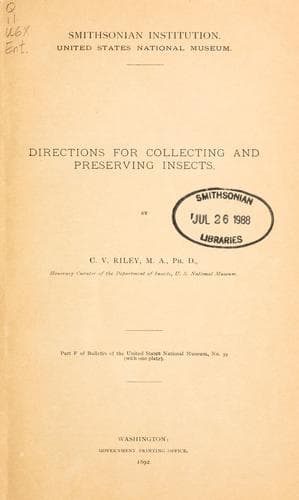
Directions for Collecting and Preserving InsectsRiley, Charles V. (Charles Valentine)
Science
Directions for Collecting and Preserving Insects
Riley, Charles V. (Charles Valentine)
Insects -- Collection and preservation
For Cecidomyidae, Agromyzidae, Cynipidae, and other small insects liable to
shrink, yet containing but little moisture, such as Poduridae,
Pediculidae, Psyllidae, etc., another method is adopted. Over the insect,
mounted on a wire, etc., as above directed, a thin chemical reagent
glass or glass rod, heated strongly at one end, is held, and the heat
involved is generally sufficient to bring about the immediate drying and
distention, but if the heat be too little the process must be repeated;
and, although by this method the danger of burning is not obviated, yet
the position of the legs is maintained much better than by the aforesaid
roasting.
Larvae of all kinds, up to the size of that of _Astynomus aedilis_, even
when they have long been kept in spirits, may be treated successfully by
the roasting method; but with these objects care must be taken that the
heat is not too strong or else the form will be distorted. For small
larvae it is preferable to use a short glass, in order better to effect
their removal without touching the upper part, which becomes covered
with steam, and contact with which would cause the destruction of the
preparation. Larvae of Coleoptera, which contain much moisture or have a
mucous surface, must lie on a bed of paper or pith in order to prevent
adhesion and burning, and these may be further avoided if the cylinder
be slightly shaken during the process, and the position of the object be
thereby changed.
Many Aphides and Coccids are covered with a waxy secretion which
interferes very materially with their easy examination. Mr. Howard has
overcome this difficulty by the following treatment:
"With Aphides and Coccids which are covered with an abundant waxy
secretion which can not be readily brushed away, we have adopted the
plan of melting the wax. We place the insect on a bit of platinum foil
and pass it once over the flame of the alcohol lamp. The wax melts at a
surprisingly low temperature and leaves the insect perfectly clean for
study. This method is particularly of use in the removal of the waxy
cocoon of the pupae of male Coccidae, and is quicker and more thorough
than the use of any of the chemical wax solvents which we have tried."
(_Insect Life_, I, p. 152.)
Public-domain text, read in full here on John Shaqi.
Reviews
Reviews
No reviews yet
Be the first to share your thoughts on this work.
Elsewhere in the archive
Join the Discussion
Join the discussion
Sign in to leave a comment or review.
Sign InorCreate an account