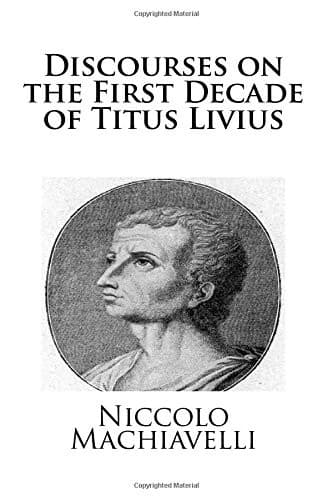
Discourses on the First Decade of Titus LiviusMachiavelli, Niccolò
Philosophy
Discourses on the First Decade of Titus Livius
Machiavelli, Niccolò
Livy. Ab urbe condita; Political science -- Early works to 1800; Rome -- Historiography
But the most recent, and in all respects most noteworthy instance, and
that which best demonstrates the futility of building, and the
advantage of destroying fortresses, is what happened only the other day
in Genoa. Every one knows how, in 1507, Genoa rose in rebellion against
Louis XII. of France, who came in person and with all his forces to
recover it; and after recovering it built there a citadel stronger than
any before known, being, both from its position and from every other
circumstance, most inaccessible to attack. For standing on the
extremity of a hill, named by the Genoese Codefa, which juts out into
the sea, it commanded the whole harbour and the greater part of the
town. But, afterwards, in the year 1512, when the French were driven
out of Italy, the Genoese, in spite of this citadel, again rebelled,
and Ottaviano Fregoso assuming the government, after the greatest
efforts, continued over a period of sixteen months, at last succeeded
in reducing the citadel by famine. By all it was believed that he would
retain it as a rock of refuge in case of any reverse of fortune, and by
some he was advised to do so; but he, being a truly wise ruler, and
knowing well that it is by the attachment of their subjects and not by
the strength of their fortifications that princes are maintained in
their governments, dismantled this citadel; and founding his authority,
not upon material defences, but on his own valour and prudence, kept
and still keeps it. And whereas, formerly, a force of a thousand
foot-soldiers could effect a change in the government of Genoa, the
enemies of Ottaviano have assailed him with ten thousand, without being
able to harm him.
Here, then, we see that, while to dismantle this fortress occasioned
Ottaviano no loss, its construction gave the French king no sort of
advantage. For when he could come into Italy with an army, he could
recover Genoa, though he had no citadel there; but when he could not
come with an army, it was not in his power to hold the city by means of
the citadel. Moreover it was costly for the king to build, and shameful
for him to lose this fortress; while for Ottaviano it was glorious to
take, and advantageous to destroy it.
Public-domain text, read in full here on John Shaqi.
Reviews
Reviews
No reviews yet
Be the first to share your thoughts on this work.
Elsewhere in the archive
Join the Discussion
Join the discussion
Sign in to leave a comment or review.
Sign InorCreate an account