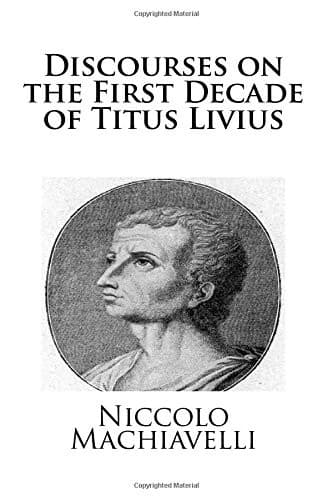
Discourses on the First Decade of Titus LiviusMachiavelli, Niccolò
Philosophy
Discourses on the First Decade of Titus Livius
Machiavelli, Niccolò
Livy. Ab urbe condita; Political science -- Early works to 1800; Rome -- Historiography
Of Manlius also, Titus Livius speaks in like honourable terms, pointing
out that his severity in putting his son to death brought the Roman
army to that pitch of discipline which enabled it to prevail against
the Latins, nay, he goes so far in his praises that after describing
the whole order of the battle, comparing the strength of both armies,
and showing all the dangers the Romans ran, and the difficulties they
had to surmount, he winds up by saying, that it was the valour of
Manlius which alone gained for them this great victory, and that
whichever side had Manlius for its leader must have won the day. So
that weighing all that the historians tell us of these two captains, it
might be difficult to decide between them.
Nevertheless, not to leave the question entirely open, I say, that for
a citizen living under a republic, I think the conduct of Manlius more
deserving of praise and less dangerous in its consequences. For methods
like his tend only to the public good and in no way subserve private
ends. He who shows himself harsh and stern at all times and to all men
alike, and is seen to care only for the common welfare, will never gain
himself partisans, since this is not the way to win personal friends,
to whom, as I said before, the name of partisans is given. For a
republic, therefore, no line of conduct could be more useful or more to
be desired than this, because in following it the public interest is
not neglected, and no room is given to suspect personal ambition.
But the contrary holds as to the methods followed by Valerius. For
though the public service they render be the same, misgivings must
needs arise that the personal good-will which, in the course of a
prolonged command, a captain obtains from his soldiers, may lead to
consequences fatal to the public liberty. And if this was not found to
happen in the case of Valerius, it was because the minds of the Roman
people were not yet corrupted, and because they had never remained for
a long time and continuously under his command.
Public-domain text, read in full here on John Shaqi.
Reviews
Reviews
No reviews yet
Be the first to share your thoughts on this work.
Elsewhere in the archive
Join the Discussion
Join the discussion
Sign in to leave a comment or review.
Sign InorCreate an account