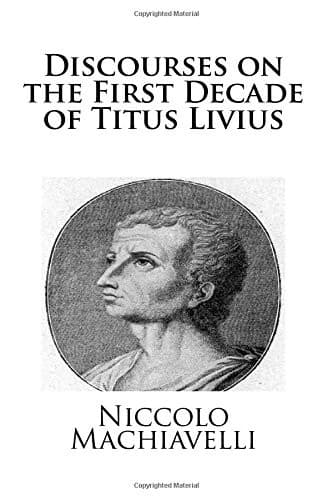
Discourses on the First Decade of Titus LiviusMachiavelli, Niccolò
Philosophy
Discourses on the First Decade of Titus Livius
Machiavelli, Niccolò
Livy. Ab urbe condita; Political science -- Early works to 1800; Rome -- Historiography
We may gather from this passage how a brave and prudent man should act,
how much good he may effect, and how serviceable he may be to his
country, when by the force of his character and worth he succeeds in
extinguishing envy. For this often disables men from acting to the best
advantage, not permitting them to obtain that authority which it is
essential they should have in matters of importance. Now, envy may be
extinguished in one or other of two ways: first, by the approach of
some flagrant danger, whereby seeing themselves like to be overwhelmed,
all forego their own private ambition and lend a willing obedience to
him who counts on his valour to rescue them. As in the case of
Camillas, who from having given many proofs of surpassing ability, and
from having been three times dictator and always exercised the office
for the public good and not for his private advantage, had brought men
to fear nothing from his advancement; while his fame and reputation
made it no shame for them to recognize him as their superior. Wisely,
therefore, does Titus Livius use concerning him the words which I have
cited.
The other way in which envy may be extinguished, is by the death,
whether by violence or in the ordinary course of nature, of those who
have been your rivals in the pursuit of fame or power, and who seeing
you better esteemed than themselves, could never acquiesce in your
superiority or put up with it in patience. For when these men have been
brought up in a corrupt city, where their training is little likely to
improve them, nothing that can happen will induce them to withdraw
their pretensions; nay, to have their own way and satisfy their
perverse humour, they will be content to look on while their country is
ruined. For envy such as this there is no cure save by the death of
those of whom it has taken possession. And when fortune so befriends a
great man that his rivals are removed from his path by a natural death,
his glory is established without scandal or offence, since he is then
able to display his great qualities unhindered. But when fortune is not
thus propitious to him, he must contrive other means to rid himself of
rivals, and must do so successfully before he can accomplish anything.
Any one who reads with intelligence the lessons of Holy Writ, will
remember how Moses, to give effect to his laws and ordinances, was
constrained to put to death an endless number of those who out of mere
envy withstood his designs. The necessity of this course was well
understood by the Friar Girolamo Savonarola, and by the Gonfalonier
Piero Soderini. But the former could not comply with it, because, as a
friar, he himself lacked the needful authority; while those of his
followers who might have exercised that authority, did not rightly
comprehend his teaching. This, however, was no fault of his; for his
sermons are full of invectives and attacks against “_the wise of this
world_,” that being the name he gave to envious rivals and to all who
Public-domain text, read in full here on John Shaqi.
Reviews
Reviews
No reviews yet
Be the first to share your thoughts on this work.
Elsewhere in the archive
Join the Discussion
Join the discussion
Sign in to leave a comment or review.
Sign InorCreate an account