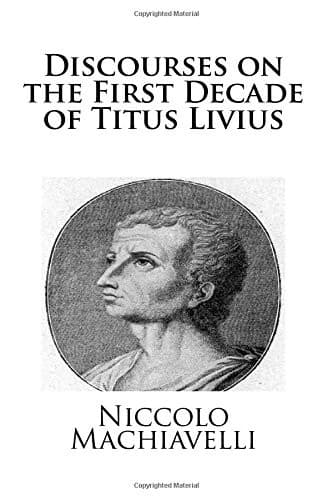
Discourses on the First Decade of Titus LiviusMachiavelli, Niccolò
Philosophy
Discourses on the First Decade of Titus Livius
Machiavelli, Niccolò
Livy. Ab urbe condita; Political science -- Early works to 1800; Rome -- Historiography
opposed his reforms. As for Piero Soderini, he was possessed by the
belief that in time and with favourable fortune he could allay envy by
gentleness-and by benefits conferred on particular men; for as he was
still in the prime of life, and in the fresh enjoyment of that
good-will which his character and opinions had gained for him, he
thought to get the better of all who out of jealousy opposed him,
without giving occasion for tumult, violence, or disorder; not knowing
how time stays not, worth suffices not, fortune shifts, and malice will
not be won over by any benefit Wherefore, because they could not or
knew not how to vanquish this envy, the two whom I have named came to
their downfall.
Another point to be noted in the passage we are considering, is the
careful provision made by Camillus for the safety of Rome both within
and without the city. And, truly, not without reason do wise
historians, like our author, set forth certain events with much
minuteness and detail, to the end that those who come after may learn
how to protect themselves in like dangers. Further, we have to note
that there is no more hazardous or less useful defence than one
conducted without method or system. This is shown in Camillus causing a
third army to be enrolled that it might be left in Rome for the
protection of the city. Many persons, doubtless, both then and now,
would esteem this precaution superfluous, thinking that as the Romans
were a warlike people and constantly under arms, there could be no
occasion for a special levy, and that it was time enough to arm when
the need came. But Camillus, and any other equally prudent captain
would be of the same mind, judged otherwise, not permitting the
multitude to take up arms unless they were to be bound by the rules and
discipline of military service. Let him, therefore, who is called on to
defend a city, taking example by Camillus, before all things avoid
placing arms in the hands of an undisciplined multitude, but first of
all select and enroll those whom he proposes to arm, so that they may
be wholly governed by him as to where they shall assemble and whither
they shall march; and then let him direct those who are not enrolled,
to abide every man in his own house for its defence. Whosoever observes
this method in a city which is attacked, will be able to defend it with
ease; but whosoever disregards it, and follows not the example of
Camillus, shall never succeed.
CHAPTER XXXI.—_That strong Republics and valiant Men preserve through
every change the same Spirit and Bearing._
Public-domain text, read in full here on John Shaqi.
Reviews
Reviews
No reviews yet
Be the first to share your thoughts on this work.
Elsewhere in the archive
Join the Discussion
Join the discussion
Sign in to leave a comment or review.
Sign InorCreate an account