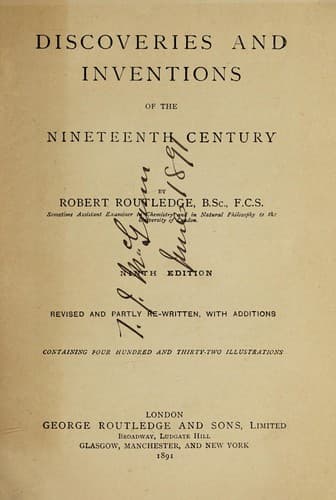
Discoveries and Inventions of the Nineteenth CenturyRoutledge, Robert
History
Discoveries and Inventions of the Nineteenth Century
Routledge, Robert
Inventions -- History -- 19th century
piers in forming the supports of the first storey some 170 feet above
the base. The arches which spring from the ground and rise nearly to the
level of these girders are not so much intended to add to the strength
of the structure as to increase its architectural effect. The first
storey stands about 180 feet above the ground, and is provided with
arcades, from which fine views of Paris may be obtained. Here there are
spacious restaurants of four different nationalities. And in the centre
of the second storey (380 feet high) is a station where passengers
change from the inclined lifts to enter other elevators that ascend
vertically to the higher stages of the tower. On the third storey, 900
feet above the ground, there is a saloon more than 50 feet square,
completely shut in by glass, whence a vast panorama may be contemplated.
Above this again are laboratories and scientific observatories, and,
crowning all, is the lighthouse, provided with a system of optical
apparatus for projecting the rays from a powerful electric light. This
light has been seen from the Cathedral at Orléans, a distance of about
70 miles.
[Illustration:
FIG. 26_c_.—_The Eiffel Tower._
]
The buildings of the Paris Exhibition of 1889 are themselves splendid
examples, not only of engineering skill, but of good taste and elegant
design in iron structures and their decorations. The vast _Salle des
Machines_ (machinery hall) exceeds in dimensions anything of the kind in
existence, for it is nearly a quarter of a mile long, and its roof
covers at one span its width of 380 feet, rising to a height of 150 feet
in the centre. This great hall is to remain permanently, as well as the
other principal galleries with their graceful domes.
The Eiffel Tower having proved one of the most striking features of the
great Paris Exhibition, and of itself a novelty sufficient to attract
visitors to the spot, and having, long before the Exhibition closed,
completely defrayed the expense of its construction, with a handsome
profit besides, its success has naturally provoked similar
enterprises,—as, for instance, at Blackpool, a seaside resort in
Lancashire, there has been erected an openwork metal tower, resembling
the Paris structure, but of far less altitude.
_Tall Buildings in American Cities._
Public-domain text, read in full here on John Shaqi.
Reviews
Reviews
No reviews yet
Be the first to share your thoughts on this work.
Elsewhere in the archive
Join the Discussion
Join the discussion
Sign in to leave a comment or review.
Sign InorCreate an account