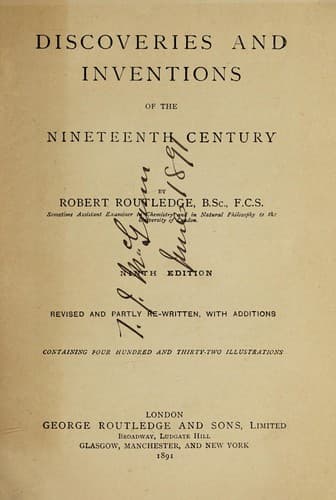
Discoveries and Inventions of the Nineteenth CenturyRoutledge, Robert
History
Discoveries and Inventions of the Nineteenth Century
Routledge, Robert
Inventions -- History -- 19th century
The tower rests on four independent foundations, each at the angle of a
square of about 330 feet in the side, and it may be noted that the two
foundations near the Seine had to be differently treated from the other
two, where a bed of gravel 18 feet thick was found at 23 feet below the
surface, and where a bed of concrete, 7 feet thick, gave a good
foundation. The foundations next the river had to be sunk 50 feet below
the surface to obtain perfectly good foundations. Underlying the whole
is a deep stratum of clay; but this is separated from the foundations by
a layer of gravel of sufficient thickness. Above this are beds of
concrete, covering an area of 60 square metres, and on the concrete
rests a pile of masonry. Each of the four piles is bound together by two
great iron bars, 25 feet long and 4 inches diameter, uniting the masonry
by means of iron cramps, and anchoring the support of the structure,
although its stability is already secured by its mere weight. The tower
is of curved pyramidal form, so designed that it shall be capable of
resisting wind pressure, without requiring the four corner structures to
be connected by diagonal bracing. The four curved supports are, in fact,
connected with each other only by girders at the platforms on the
several stages, until at a considerable length they are sufficiently
near to each other to admit the use of the ordinary diagonals. The work
was begun at the end of January, 1887, and M. Eiffel notes how the
imagination of the workmen was impressed by the notion of the vast
height of the intended structure. Not steel, but iron is the material
used throughout, and the weight of it is about 7,300 tons, without
reckoning what is used in the foundations, and in the machinery
connected with the lifts, etc. It has long ago been found that stone
would be an unsuitable material for a structure of this kind, and it is
obvious that only iron could possibly have been used to build a tower of
so vast a height and within so short a space of time, for it was
completed in April, 1889. A comparison of heights with the loftiest
stone edifices may not be without interest. The highest building in
Paris is the dome of the Invalides, 344 feet; Strasburg Cathedral rises
to 466 feet; the Great Pyramid to 479 feet; the apex of the spire in the
recently completed Cathedral at Cologne to 522 feet. These are
overtopped by the lofty stone obelisk the Americans have erected at
Washington, which attains a height of more than 550 feet. Such spires
and towers have been erected only at the cost of immense labour. But
iron, which can be so readily joined by riveting, lends itself
invitingly to the skill of the constructor, more particularly by reason
of the wonderful tensile strength it possesses. It is scarcely possible
to convey any adequate idea of the great complicated network of bracings
by which in the Eiffel Tower each standard of the columns is united to
the rest to form one rigid pile. The horizontal girders unite the four
Public-domain text, read in full here on John Shaqi.
Reviews
Reviews
No reviews yet
Be the first to share your thoughts on this work.
Elsewhere in the archive
Join the Discussion
Join the discussion
Sign in to leave a comment or review.
Sign InorCreate an account