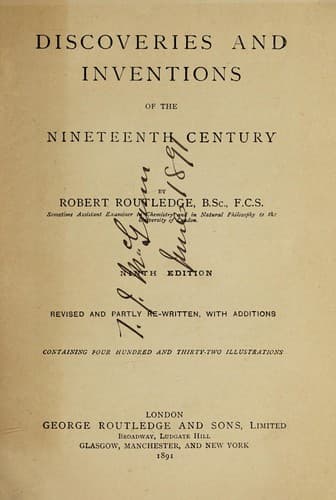
Discoveries and Inventions of the Nineteenth CenturyRoutledge, Robert
History
Discoveries and Inventions of the Nineteenth Century
Routledge, Robert
Inventions -- History -- 19th century
The kind of general interest which attaches to the tools we have already
described is not wanting in yet another class of machine-tools, namely,
those employed in converting timber into the forms required to adapt it
for the uses to which it is so extensively applied. And for popular
illustration, this class of tools presents the special advantage of
being readily understood as regards their purpose and mode of action,
while their simplicity in these respects does not prevent them from
showing the advantages of machine over hand labour. Everybody is
familiar with the up-and-down movement of a common saw, and in the
machine for sawing balks of timber into planks, represented in Fig. 36,
this reciprocating motion is retained, but there are a number of saws
fixed parallel to each other in a strong frame, at a distance
corresponding to the thickness of the planks. The saws are not placed
with their cutting edges quite upright, but these are a little more
forward at the top, so that as they descend they cut into the wood, but
move upwards without cutting, for the teeth then recede from the line of
the previous cut, while in the meantime the balk is pushed forward ready
for the next descent of the saw-frame. This pushing forward, or
_feeding_, of the timber is accomplished by means of ratchet-wheels,
which are made to revolve through a certain space after each descent of
the saw-frame, and, by turning certain pinions, move forward the
carriage on which the piece of timber is firmly fixed, so that when the
blades of the saws are beginning the next descent they are already in
contact with the edge of the former cut. To prevent the blades from
moving with injurious friction in the saw-cuts, these last are made of
somewhat greater width than the thickness of the blades, by the simple
plan of bending the teeth a little on one side and on the other
alternately. The rapidity with which the machine works, depends of
course on the kind of wood operated upon, but it is not unusual for such
a machine to make more than a hundred cuts in the minute. The figure
shows the machine as deriving its motion by means of a strap passing
over a drum, from shafting driven by a steam engine. This is the usual
plan, but sometimes the steam power is applied directly, by fixing the
piston-rod of a steam cylinder to the top of the saw-frame, and
equalizing the motion by a fly-wheel on a shaft, turned by a crank and
connecting-rod.
Public-domain text, read in full here on John Shaqi.
Reviews
Reviews
No reviews yet
Be the first to share your thoughts on this work.
Elsewhere in the archive
Join the Discussion
Join the discussion
Sign in to leave a comment or review.
Sign InorCreate an account