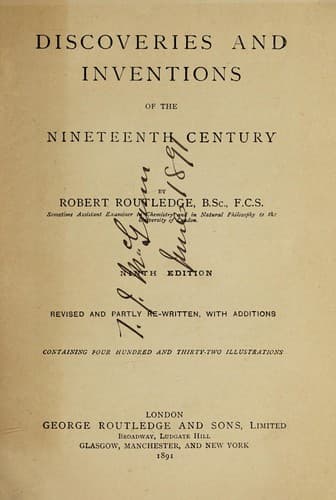
Discoveries and Inventions of the Nineteenth CenturyRoutledge, Robert
History
Discoveries and Inventions of the Nineteenth Century
Routledge, Robert
Inventions -- History -- 19th century
A very effective machine for cutting pieces of wood of moderate
dimensions is the _Circular Saw_, represented in Fig. 37. Here there is
a steel disc, having its rim formed into teeth; and the disc is made to
revolve with very great speed, in some cases making as many as five
hundred turns in a minute, or more than eight in a second. On the bench
is an adjustable straight guide, or fence, and when this has been fixed,
the workman has only to press the piece of wood against it, and push the
wood at the same time towards the saw, which cuts it at a very rapid
rate. Sometimes the circular saw is provided with apparatus by which the
machine itself pushes the wood forwards, and the only attention required
from the workman is the fixing of the wood upon the bench, and the
setting of the machine in gear with the driving-shaft. Similar saws are
used for squaring the ends of the iron rails for railways, two circular
saws being fixed upon one axle at a distance apart equal to the length
of the rails. The axle is driven at the rate of about 900 turns per
minute, and the iron rail is brought up parallel to the axle, being
mounted on a carriage, and still red hot, when the two ends are cut at
the same time by the circular saws, the lower parts of which dip into
troughs of water to keep them cool.
[Illustration:
FIG. 38.—_Pit-Saw._
]
[Illustration:
FIG. 39.—_Box Tunnel._
]
RAILWAYS.
[Illustration:
FIG. 40.—_Coal-pit, Salop._
]
Towards the end of last century, tramways formed by laying down narrow
plates of iron, were in use at mines and collieries in several parts of
England. These plates had usually a projection or flange on the inner
edge, thus—L, in order to keep the waggons on the track, for the wheels
themselves had no flange, but were of the kind used on ordinary roads.
These flat tramways were found liable to become covered up with dirt and
gravel, so that the benefit which ought to have been obtained from their
smoothness was in a great measure lost. _Edge rails_ were, therefore,
substituted, and the wheels were kept on the rails by having a _flange_
cast on the inner edge of the rim. The rails were then always made of
cast iron, for, although they were very liable to break, the great cost
of making them of wrought iron prevented that material from being used
until 1820, when the method of forming rails of malleable iron by
rolling came into use. The first time a tramway was used for the
conveyance of passengers was in 1825, when the Stockton and Darlington
Railway was opened—a length of thirty-seven miles. It appears that the
carriages were at first drawn by horses, although locomotives were used
on this and other colliery lines for dragging, at a slow rate, trains of
mineral waggons. At that time engineers were exercising their ingenuity
in overcoming a difficulty which never existed by devising plans for
giving tractive power to the locomotive through the instrumentality of
rack-work rails.
Public-domain text, read in full here on John Shaqi.
Reviews
Reviews
No reviews yet
Be the first to share your thoughts on this work.
Elsewhere in the archive
Join the Discussion
Join the discussion
Sign in to leave a comment or review.
Sign InorCreate an account