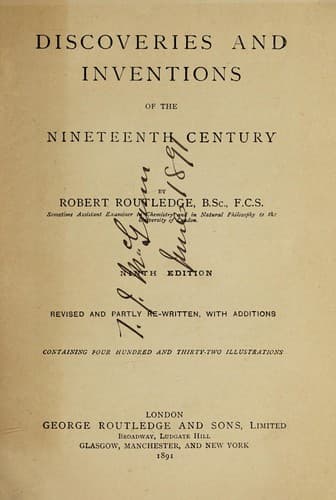
Discoveries and Inventions of the Nineteenth CenturyRoutledge, Robert
History
Discoveries and Inventions of the Nineteenth Century
Routledge, Robert
Inventions -- History -- 19th century
It never occurred to them to first try whether the
adhesion of the smooth wheel to the smooth rail was not sufficient for
the purpose. During the first quarter of the present century the greater
part of the goods and much passenger traffic was monopolized by the
canals. It is quoted, as a proof of the careless manner in which this
service was performed, that the transport of bales of cotton from
Liverpool to Manchester sometimes occupied twice the length of time
required in their voyage across the Atlantic. When an Act of Parliament
authorizing the construction of a railway between Liverpool and
Manchester was applied for, the canal companies succeeded in retarding,
by their influence, the passing of that Act for two years. It was
passed, however, in 1828, and the construction of the line was proceeded
with. This line was at first intended only for the conveyance of goods,
especially of cotton and cotton manufactures, and the waggons were to be
drawn by horses. When the line was nearly finished the idea of employing
horses was, at the instigation of Mr. George Stephenson, abandoned in
favour of steam power. The directors were divided in opinion as to
whether the carriage should be dragged by ropes wound on large drums by
stationary engines, or whether locomotives should be employed. Finally,
the latter plan was adopted, and it was also suggested that passengers
might be carried. The directors offered a prize for the best locomotive,
and the result has been already mentioned. In the light of our
experience since that time, it is curious to read of the doubts then
entertained by skilful engineers about the success of the locomotive. In
a serious treatise on the subject, one eminent authority hoped “that he
might not be confounded with those hot-brained enthusiasts who
maintained the possibility of carriages being driven by a steam engine
on a railway at such a speed as twelve miles an hour.” When the “Rocket”
had accomplished the unprecedented velocity of twenty-nine miles an
hour, and the railway was opened for passengers as well as goods, the
thirty stage coaches daily plying between Liverpool and Manchester found
their occupation gone, and all ceased to run except one, which had to
depend on the roadside towns only, while the daily number of passengers
between the two cities rose at once from 500 to 1,600. In that
delightful book, Smiles’s “Life of George Stephenson,” may be found most
interesting details of the difficulties attending the introduction of
railways, especially with regard to the construction of this first
important line. Mr. Smiles relates how the promoters of the scheme
struggled against “vested interests;” how the canal proprietors,
confident at first of a secure and continuous enjoyment of their
monopoly, ridiculed the proposed railway, and continued their exorbitant
charges and tardy conveyance, pocketing in profits the prime cost of
their canal about every three years; how, roused into active opposition,
Public-domain text, read in full here on John Shaqi.
Reviews
Reviews
No reviews yet
Be the first to share your thoughts on this work.
Elsewhere in the archive
Join the Discussion
Join the discussion
Sign in to leave a comment or review.
Sign InorCreate an account