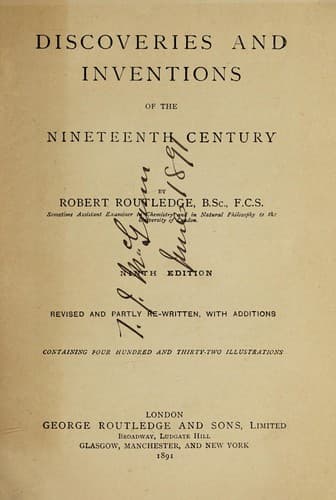
Discoveries and Inventions of the Nineteenth CenturyRoutledge, Robert
History
Discoveries and Inventions of the Nineteenth Century
Routledge, Robert
Inventions -- History -- 19th century
A very clear account of the mode of working railway signals on what is
now called the _block system_, together with a graphic description of a
signal-box, was given in a paper which appeared some years ago in “The
Popular Science Review,” from the pen of Mr. Charles V. Walker, F.R.S.,
the telegraph engineer to the South-Eastern Railway Company, who was the
first to organize an efficient system of electric signalling for
railways. We may remark that the signalling instruments on the
South-Eastern line, and indeed on all the lines at the present day,
address themselves both to the ear and to the eye, for they consist
of—first, bells, on which one, two, or more blows are struck, each
series of blows having its own particular meaning; and, second, of a
kind of miniature signal-post, with arms capable of being moved by
electric currents into positions similar to those of the arm of an
actual signal-post, so that the position of the arms is made always to
indicate the state of the line. One arm of the little signal-post—the
left—is red, and it has reference to _receding_ trains; the other—viz.,
the right—arm is white, and relates to _approaching_ trains. Mr. Walker
thus describes the signalling:
“The ordinary position of the arms of the electro-magnetic telegraph
semaphores will be down; that is to say, when the line is clear of all
trains, and business begins, say in early morning, all the arms will be
down, indicating that no train is moving. When the first train is ready
to start, say from Charing Cross, the signalman will give the proper
bell-signal to Belvidere—two, three, or four blows, according as the
train is for Greenwich, for North Kent, or Mid-Kent, or for the main
line; and the Belvidere man will acknowledge this by one blow on the
bell in reply, and without raising the Charing Cross red or left arm.
This is the signal that the train may go on; and when the train has
passed, so that the Charing Cross man can see the tail lights, he gives
the out signal a second time, which the Belvidere man acknowledges, at
the same time raising the red arm at Charing Cross, behind the train,
and so protecting it until it has passed him at Belvidere, when he
signals to that effect to Charing Cross, at the same time putting down
the red arm there, as an indication that the line is again clear. While
these operations are going on for down trains, others precisely similar,
but in the reverse direction, are going on for up trains.... One and the
same pressure on the key sends a bell signal and raises or depresses the
semaphore arm as the case may require, a single telegraph wire only
being required for the combined system, as for the more simple bell
system.” In one of the signal-boxes on the South-Eastern line, Mr.
Walker states, on a certain day 650 trains or engines were signalled and
all particulars accurately entered in a book, the entries requiring the
writing down of nearly 8,000 figures: an illustration of the amount of
Public-domain text, read in full here on John Shaqi.
Reviews
Reviews
No reviews yet
Be the first to share your thoughts on this work.
Elsewhere in the archive
Join the Discussion
Join the discussion
Sign in to leave a comment or review.
Sign InorCreate an account