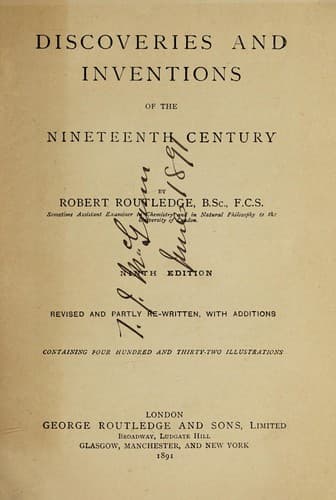
Discoveries and Inventions of the Nineteenth CenturyRoutledge, Robert
History
Discoveries and Inventions of the Nineteenth Century
Routledge, Robert
Inventions -- History -- 19th century
work quietly carried on in a signal-box for the advantage and security
of the travelling public.
Mr. Walker also gives us a peep into the inside of one of the
signal-boxes, thus: “The interior of a large signal-box exhibits a very
animated scene, in which there are but two actors, a man and a boy, both
as busy as bees, but with no hurry or bustle. The ruling genius of the
place is the strong, active, intelligent signalman, standing at one end
of the apartment, the monarch for the time being of all he surveys.
Immediately before him in one long line, extending from side to side, is
a goodly array of levers, bright and clean from constant use and careful
tending, each one labelled for its respective duty. Before him to the
right and left are the various electro-magnetic semaphores, each one in
full view and adjusted in position to the pair of roads to which it is
appropriated, and all furnished with porcelain labels. Directly in front
of him is a screen, along which are arranged the various semaphore keys;
and on brackets, discreetly distributed, are the bells and gongs, the
twin companions each of its own semaphore. Before the screen are the
writing-desk and books, and here stands the youngster, the ministering
spirit, all on the alert to take or to send electric signals and to
record them, his time and attention being devoted alternately to his
semaphore keys and to his books, being immediately under the eye and
control of the signalman. This is no place for visitors, and the scenes
enacted here have little chance of meeting the public gaze; indeed, the
officers whose duties take them hither occasionally are only too glad to
look on, and say as little as may be, and not interrupt the active pair,
between whom there is evidently a good understanding in the discharge of
duties upon the accurate performance of which so much depends. Looking
on, the man will be seen in command of his rank and file: signals come,
are heard and seen by both man and boy; levers are drawn and withdrawn,
one, two, three, or more; the arms and the lamps on the gigantic masts
outside, of which there are three, well laden, are displayed as
required, distant signals are moved, points are shifted and roads made
ready; telegraph signals are acknowledged; and on looking out—for the
box is glazed throughout—trains are seen moving in accordance with the
signals made; and on the signal-posts at the boxes, right and left—for
here they are within easy reach of each other—arms are seen up and down
in sympathy with those on the spot, and with the telegraph signals that
have been interchanged. There is no cessation to this work, and there is
no confusion in it; one head and hand directs the whole, so that there
are no conflicting interests and no misunderstandings; all is done in
perfect tranquillity, and the great secret is that one thing is done at
a time. All this, which is so simple and so full of meaning to the
Public-domain text, read in full here on John Shaqi.
Reviews
Reviews
No reviews yet
Be the first to share your thoughts on this work.
Elsewhere in the archive
Join the Discussion
Join the discussion
Sign in to leave a comment or review.
Sign InorCreate an account