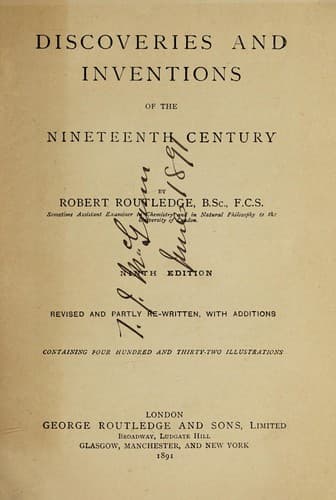
Discoveries and Inventions of the Nineteenth CenturyRoutledge, Robert
History
Discoveries and Inventions of the Nineteenth Century
Routledge, Robert
Inventions -- History -- 19th century
England has had to borrow from the United States not a few hints for
such adaptations and appliances as tend to promote the comfort and
convenience of travellers by rail, especially on what we insularly call
long journeys. Some of these vehicles on the American railways are
luxurious hotels upon wheels; they contain accommodation for forty
persons, having a kitchen, hot and cold water, wine, china and linen
closets, and more than a hundred different articles of food, besides an
ample supply of tablecloths, table napkins, towels, sheets, pillowcases,
&c. Then there are other Pullman inventions, such as the “palace” and
the “sleeping” cars, in which the traveller who is performing a long
journey makes himself at home for days, or perhaps for a week, as, for
instance, while he is being carried across the American continent from
ocean to ocean at the easy rate of twenty miles an hour on the Pacific
and other connecting lines. Mr. C. Nordhoff, an American writer, giving
an account of his journey to the Western States, writes thus: “Having
unpacked your books and unstrapped your wraps in your Pullman or Central
Pacific palace car, you may pursue all the sedentary avocations and
amusements of a parlour at home; and as your housekeeping is done—and
admirably done—for you by alert and experienced servants; as you may lie
down at full length, or sit up, sleep, or wake at your choice; as your
dinner is sure to be abundant, very tolerably cooked, and not hurried;
as you are pretty certain to make acquaintances in the car; and as the
country through which you pass is strange and abounds in curious and
interesting sights, and the air is fresh and exhilarating—you soon fall
into the ways of the voyage; and if you are a tired business man or a
wearied housekeeper, your careless ease will be such a rest as certainly
most busy and overworked Americans know how to enjoy. You write
comfortably at a table in a little room called a ‘drawing-room,’
entirely closed off, if you wish it, from the remainder of the car,
which room contains two large and comfortable armchairs and a sofa, two
broad clean plate-glass windows on each side (which may be doubled if
the weather is cold), hooks in abundance for shawls, hats, &c., and
mirrors at every corner. Books and photographs lie on the table. Your
wife sits at the window sewing and looking out on long ranges of
snow-clad mountains or on boundless ocean-like plains. Children play on
the floor or watch at the windows for the comical prairie dogs sitting
near their holes, and turning laughable somersaults as the car sweeps
by. The porter calls you at any hour you appoint in the morning; he
gives half an hour’s notice of breakfast, dinner, or supper; and while
you are at breakfast, your beds are made up and your room or your
section aired. About eight o’clock in the evening—for, as at sea, you
keep good hours—the porter, in a clean grey uniform, comes in to make up
the beds. The two easy-chairs are turned into a berth; the sofa
Public-domain text, read in full here on John Shaqi.
Reviews
Reviews
No reviews yet
Be the first to share your thoughts on this work.
Elsewhere in the archive
Join the Discussion
Join the discussion
Sign in to leave a comment or review.
Sign InorCreate an account