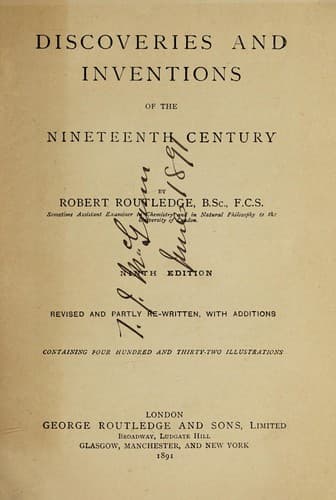
Discoveries and Inventions of the Nineteenth CenturyRoutledge, Robert
History
Discoveries and Inventions of the Nineteenth Century
Routledge, Robert
Inventions -- History -- 19th century
undergoes a similar transformation; the table, having its legs pulled
together, disappears in a corner, and two shelves being let down furnish
two other berths. The freshest and whitest of linen and
brightly-coloured blankets complete the outfit; and you undress and go
to bed as you would at home.”
An important general truth may find a familiar illustration in the
subject now under notice. The truth in question may be expressed by
saying that, in all human affairs, as well as in the operations of
nature, the state of things at any one time is the result, by a sort of
growth, of a preceding state of things. And in this way it is certainly
true of inventions, that they never make their appearance suddenly in a
complete and finished state—like Minerva, who is fabled to have sprung
from the brain of Jupiter fully grown and completely armed; but rather
their history resembles the slow and progressive process by which
ordinary mortals attain to their full stature. We have already seen that
railways had their origin in the tramways of collieries; and, in like
manner, the railway carriage grew out of the colliery truck and the
stage coach; for when railway carriages to convey passengers were first
made, it did not occur to their designers that anything better could be
done than to place coach bodies on the frame of the truck; and
accordingly the early railway carriages were formed by mounting the body
of a stage coach, or two or three such bodies side by side, on the
timber framework which was supported by the flanged wheels. The cut,
Fig. 56, is from a painting in the possession of the Connecticut
Historical Society, and it represents the first railway train in America
on its trial trip (1831), in which sixteen persons took part, who were
then thought not a little courageous. Here we see that the carriages
were regular stage coaches, and the same was the case in England. But it
is very significant that, to this day, the stage coach bodies are
traceable in many of the carriages now running on English lines,
especially in the first-class carriages, where, in the curved lines of
the mouldings which are supposed to ornament the outside, one may easily
recognize the forms of the curved bodies of the stage coaches, although
there is nothing whatever, in the real framing of the timbers of the
railway carriage, which has the most distant relation to these curves.
Then again, almost universally on English lines, the old stage coach
door-handles are still retained on the first-class carriages, in the
awkward flat oval plates of brass which fold down with a hinge. Many
other points might be named which would show the persistence of the
stage coach type on the English railways. The cut, Fig. 56, proves that
the Americans set out with the same style of carriages; but North
America, as compared with the Old World, is _par excellence_ the country
of rapid developments, and there carriages, or cars, as our
Public-domain text, read in full here on John Shaqi.
Reviews
Reviews
No reviews yet
Be the first to share your thoughts on this work.
Elsewhere in the archive
Join the Discussion
Join the discussion
Sign in to leave a comment or review.
Sign InorCreate an account