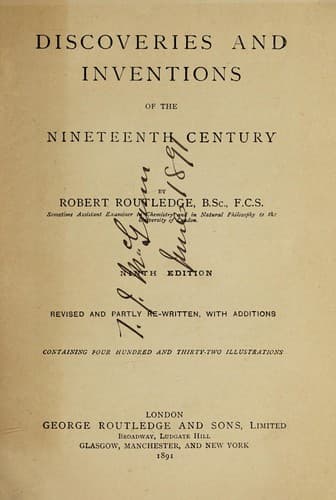
Discoveries and Inventions of the Nineteenth CenturyRoutledge, Robert
History
Discoveries and Inventions of the Nineteenth Century
Routledge, Robert
Inventions -- History -- 19th century
The remarkable development of railways which has taken place in the
United States has its most striking illustration in the great system of
lines by which the whole continent can be traversed from shore to shore.
The distance by rail from New York to San Francisco is 3,215 miles, and
the journey occupies about a week, the trains travelling night and day.
The traveller proceeding from the Eastern States to the far west has the
choice of many routes, but these all converge to Omaha. From this point
the Pacific Railroad will convey him towards the land of the setting
sun. The map, Fig. 51, shows the course of this railway, which is the
longest in the world. It traverses broader plains and crosses higher
mountains than any other. Engineering skill of the most admirable kind
has been displayed in the laying-out and in the construction of the
line, with its innumerable cuttings, bridges, tunnels, and snow-sheds.
[Illustration:
FIG. 51.—_Map of the Route of the Pacific Railway._
]
The road from Omaha to Ogden, near the Great Salt Lake—a distance of
1,032 miles—is owned by the Union Pacific Company, and the Central
Pacific joins the former at Ogden and completes the communication to San
Francisco, a further length of 889 miles—the whole distance from Omaha
to San Francisco being 1,911 miles. The Union Pacific was commenced in
November, 1865, and completed in May, 1869. There are at Omaha extensive
workshops provided with all the appliances for constructing and
repairing locomotives and carriages, and these works cover 30 acres of
ground, and give employment to several thousand men. The population of
Omaha rose during the making of the railway from under 3,000 in 1864 to
more than 16,000 in 1870, and it is now a flourishing town. A little
distance from Omaha the line approaches the Platte River, and the valley
of this river and one of its tributaries is ascended to Cheyenne, 516
miles from Omaha, the line being nowhere very far from the river’s
course. Cheyenne is 5,075 ft. higher above the sea than Omaha, the
elevation of which is 966 ft. The Platte River is a broad but very
shallow stream, with a channel continually shifting, owing to the vast
quantity of sand which its muddy waters carry down. This portion of the
line passing through a district where leagues upon leagues of fertile
land await the hand of the tiller, has opened up vast tracts of
land—hedgeless, gateless green fields, free to all, and capable of
receiving and supporting millions of human inhabitants. Cheyenne, a town
of 3,000 inhabitants, is entirely the creation of the railways, for
southward from Cheyenne a railway passes to Denver, a distance of 106
miles, through rich farming and grazing districts. Seven miles beyond
Cheyenne the line begins to ascend the Black Hills by steep gradients,
and at Granite Canyon, for example, the rise in five miles is 574 ft.,
or about 121 ft. per mile. Many lime-kilns have been erected in this
neighbourhood, where limestone is very abundant.
Public-domain text, read in full here on John Shaqi.
Reviews
Reviews
No reviews yet
Be the first to share your thoughts on this work.
Elsewhere in the archive
Join the Discussion
Join the discussion
Sign in to leave a comment or review.
Sign InorCreate an account