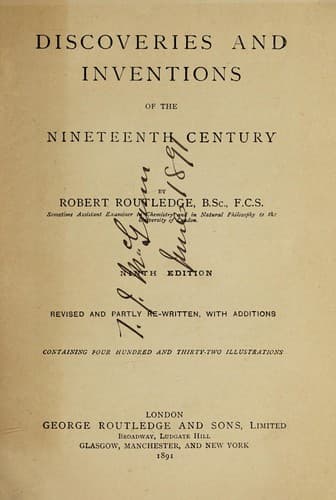
Discoveries and Inventions of the Nineteenth CenturyRoutledge, Robert
History
Discoveries and Inventions of the Nineteenth Century
Routledge, Robert
Inventions -- History -- 19th century
PLATE VII.
PIKE’S PEAK RAILWAY, ROCKY MOUNTAINS.
]
[Illustration:
FIG. 58.—_The Great Eastern at Anchor._
]
STEAM NAVIGATION.
The first practically successful steamboat was constructed by Symington,
and used on the Forth and Clyde Canal in 1802. A few years afterwards
Fulton established steam navigation in American waters, where a number
of steamboats plied regularly for some years before the invention had
received a corresponding development in England, for it was not until
1814 that a steam-packet ran for hire in the Thames. From that time,
however, the principle was quickly and extensively applied, and steamers
made their appearance on the chief rivers of Great Britain, and soon
began also to make regular passages from one sea-port to another, until
at length, in 1819, a steamer made the voyage from New York to
Liverpool. It does not appear, however, that such ocean steam voyages
became at once common, for we read that in 1825 the captain of the first
steam-ship which made the voyage to India was rewarded by a large sum of
money. It was not until 1838 that regular steam communication with
America was commenced by the dispatch of the _Great Western_ from
Bristol. Other large steamers were soon built expressly for the passage
of the Atlantic, and a new era in steam navigation was reached when, in
1845, the _Great Britain_ made her first voyage to New York in fourteen
days. This ship was of immense size, compared with her predecessors, her
length being 320 ft., and she was moreover made of iron, while instead
of paddles, she was provided with a screw-propeller, both circumstances
at that time novelties in passenger ships. Fulton appears to have made
trial in America of various forms of mechanism for propelling ships
through the water. Among other plans he tried the screw, but finally
decided in favour of paddle-wheels, and for a long time these were
universally adopted. Many ships of war were built with paddle-wheels,
but the advantages of the screw-propeller were at length perceived. The
paddle-wheels could easily be disabled by an enemy’s shot, and the large
paddle-boxes encumbered the decks and obstructed the operations of naval
warfare. Another circumstance perhaps had a greater share in the general
adoption of the screw, which had long before been proposed as a means of
applying steam power to the propulsion of vessels. This was the
introduction of a new method of placing the screw, so that its powers
were used to greater advantage. Mr. J. P. Smith obtained a patent in
1836 for placing the propeller in that part of the vessel technically
called the _dead-wood_, which is above the keel and immediately in front
of the rudder. When the means of propulsion in a ship of war is so
placed, this vital part is secure from injury by hostile projectiles,
and the decks are clear for training guns and other operations. Thus
placed, the screw has been proved to possess many advantages over
Public-domain text, read in full here on John Shaqi.
Reviews
Reviews
No reviews yet
Be the first to share your thoughts on this work.
Elsewhere in the archive
Join the Discussion
Join the discussion
Sign in to leave a comment or review.
Sign InorCreate an account