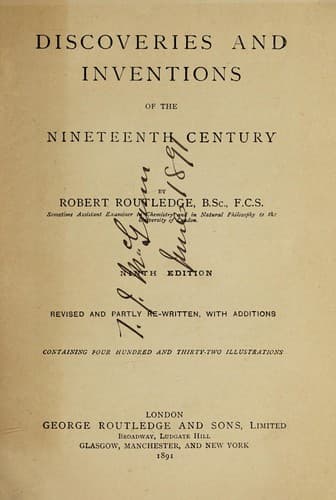
Discoveries and Inventions of the Nineteenth CenturyRoutledge, Robert
History
Discoveries and Inventions of the Nineteenth Century
Routledge, Robert
Inventions -- History -- 19th century
paddle-wheels, so that at the present time it has largely superseded
paddle-wheels in vessels of every class, except perhaps in those
intended to ply on rivers and lakes. Many fine paddle-wheel vessels are
still afloat, but sea-going steamers are nearly always now built with
screw-propellers. In the application of the steam engine to navigation
the machine has received many modifications in the form and arrangement
of the parts, but in principle the marine engine is identical with the
condensing engine already described. The engines in steam-ships are
often remarkable for the great diameter given to the cylinders, which
may be 8 ft. or 9 ft. or more. Of course other parts of the machinery
are of corresponding dimensions. Such large cylinders require the
exercise of great skill in their construction, for they must be cast in
one piece and without flaws. The engraving, Fig. 59, depicts the scene
presented at the works of Messrs. Penn during the casting of one of
these large cylinders, the weight of which may amount to perhaps 30
tons. Only the top of the mould is visible, and the molten iron is being
poured in from huge ladles, moved by powerful cranes. In paddle vessels
the great wrought iron shaft which carries the paddle-wheels crosses the
vessel from side to side. This shaft has two cranks, placed at right
angles to each, and each one is turned by an engine, which is very
commonly of the kind known as the side-lever engine. In this engine,
instead of a beam being placed above the cylinder, two beams are used,
one being set on each side of the cylinder, as low down as possible. The
top of the piston-rod is attached to a crosshead, from each end of which
hangs a great rod, which is hinged to the end of the side-beam. The
other ends of the two beams are united by a cross-bar, to which is
attached the connecting-rod that gives motion to the crank. Another
favourite form of engine for steam-ships is that with oscillating
cylinders. The paddle-wheels are constructed with an iron framework, to
which flat boards, or floats, are attached, placed usually in a radial
direction. But when thus fixed, each float enters the water obliquely,
and in fact its surface is perpendicular to the direction of the
vessel’s course only at the instant the float is vertically under the
axis of the wheel. In order to avoid the loss of power consequent upon
this oblique movement of the floats, they are sometimes hung upon
centres, and are so moved by suitable mechanism that they are always in
a nearly vertical position when passing through the water. Paddle-wheels
constructed in this manner are termed _feathering_ wheels. They do not
appear, however, to possess any great advantage over those of the
ordinary construction, except when the paddles are deeply immersed in
the water, and this result may be better understood when we reflect that
the actual path of the floats through the water is not circular, as it
Public-domain text, read in full here on John Shaqi.
Reviews
Reviews
No reviews yet
Be the first to share your thoughts on this work.
Elsewhere in the archive
Join the Discussion
Join the discussion
Sign in to leave a comment or review.
Sign InorCreate an account