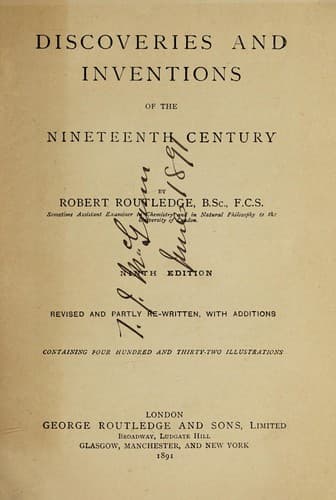
Discoveries and Inventions of the Nineteenth CenturyRoutledge, Robert
History
Discoveries and Inventions of the Nineteenth Century
Routledge, Robert
Inventions -- History -- 19th century
would be if the vessel itself did not move; for all points of the wheel
describe peculiar curves called _cycloids_, which result from the
combination of the circular with the onward movement.
[Illustration:
PLATE VIII.
THE “CLERMONT,” FROM A CONTEMPORARY DRAWING.
]
[Illustration:
FIG. 59.—_Casting Cylinder of a Marine Steam Engine._
]
The next figure, 60, exhibits a very common form of the screw propeller,
and shows the position which it occupies in the ship. The reader may not
at once understand how a comparatively small two-armed wheel revolving
in a plane perpendicular to the direction of the vessel’s motion is able
to propel the vessel forward. In order to understand the action of the
propeller, he should recall to mind the manner in which a screw-nail in
a piece of wood advances by a distance equal to its pitch at every turn.
If he will conceive a gigantic screw-nail to be attached to the vessel
extending along the keel,—and suppose for a moment that the water
surrounding this screw is not able to flow away from it, but that the
screw works through the water as the nail does in the wood,—he will have
no difficulty in understanding that, under such circumstances, if the
screw were made to revolve, it would advance and carry the vessel with
it. The reader may now form an accurate notion of the actual propeller
by supposing the imaginary screw-nail to have the thread so deeply cut
that but little solid core is left in the centre, and supposing also
that only a very short piece of the screw is used—say the length of one
revolution—and that this is placed in the dead-wood. Such was the
construction of the earlier screw-propellers, but now a still shorter
portion of the screw is used; for instead of a complete turn of the
thread, less than one-sixth is now the common construction. Such a strip
or segment of the screw-thread forms a _blade_, and two, three, four, or
more blades are attached radially to one common axis. The blades spring
when there are two from opposite points in the axis, and in other cases
from points on the same circle. The blades of the propeller are cut and
carved into every variety of shape according to the ideas of the
designer, but the fundamental principle is the same in all the forms. It
need hardly be said that the particles of the water are by no means
fixed like those of the wood in which a screw advances. But as the water
is not put in motion by the screw without offering some resistance by
reason of its inertia, this resistance reacting on the screw operates in
the same manner, but not to the same extent, as the wood in the other
case. When we know the pitch of the screw, we can calculate what
distance the screw would be moved forward in a given number of
revolutions if it were working through a solid. This distance is usually
greater than the actual distance the ship is propelled, but in some
cases the vessel is urged through the water with a greater velocity than
Public-domain text, read in full here on John Shaqi.
Reviews
Reviews
No reviews yet
Be the first to share your thoughts on this work.
Elsewhere in the archive
Join the Discussion
Join the discussion
Sign in to leave a comment or review.
Sign InorCreate an account