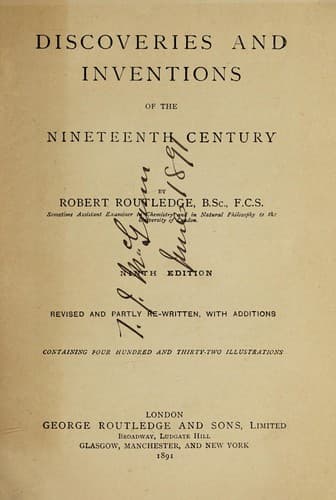
Discoveries and Inventions of the Nineteenth CenturyRoutledge, Robert
History
Discoveries and Inventions of the Nineteenth Century
Routledge, Robert
Inventions -- History -- 19th century
On board of some modern war-ships where speed is essential, and where
the engines are driven at a very great number of revolutions per minute,
as in the case of torpedo-boat catchers, the vibration throughout the
whole of the vessel becomes extremely trying, not only for the nerves of
the crew, but for the security of the structure itself. The cause of
this vibration and consequent strain and loss of power is not far to
seek. The cylinders of marine engines are always of a large diameter, 6
feet, 8 feet, or even more sometimes, and the pistons and piston-rods
are necessarily of great strength and corresponding weight. Now, at
every half revolution of the engines, this heavy mass of piston and
piston-rod, though moving at an exceedingly high speed in the middle of
the stroke, has to be brought to a standstill, and an equal velocity in
the opposite direction imparted to it. A large portion of the power is
therefore uselessly expended in stopping a great moving mass, and
reversing its motion. All the force required to do this reacts on the
vessel’s frame. Many attempts have been made to construct rotatory
steam-engines, and some hundreds of patents taken out for such
inventions, which in general have a piston revolving about a shaft; but
the great friction, and consequent liability to wear out, have prevented
their practical use.
Lately, a method of using steam on the principle embodied in the water
turbine has been developed, and within the last six or seven years has
found successful application in propelling electro-dynamos at very high
speeds. In the steam turbine there are no pistons, piston-rods, or other
reciprocating parts, the effect depending on the same kind of reaction
that is taken advantage of in the water turbine (which has a high
efficiency in giving out a large proportion of energy), and the power is
applied with smoothness and an entire absence of the oscillations that
would shake to pieces any vessel that an ordinary steam-engine could
propel at the same rate.
Public-domain text, read in full here on John Shaqi.
Reviews
Reviews
No reviews yet
Be the first to share your thoughts on this work.
Elsewhere in the archive
Join the Discussion
Join the discussion
Sign in to leave a comment or review.
Sign InorCreate an account