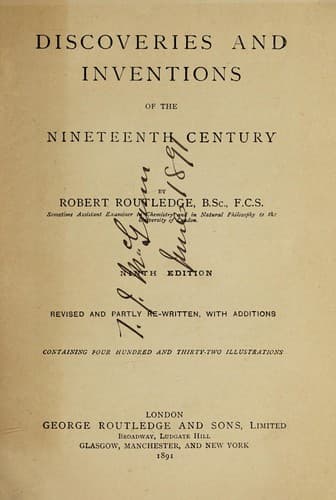
Discoveries and Inventions of the Nineteenth CenturyRoutledge, Robert
History
Discoveries and Inventions of the Nineteenth Century
Routledge, Robert
Inventions -- History -- 19th century
The advantages of the steam turbine have been proved by the performances
of a small experimental vessel lately built at Newcastle, and
appropriately named the _Turbinia_. She is only 100 feet in length, and
9 feet in breadth, with a displacement of some 44 tons. Now the highest
record speed for any vessel of that size is 24 knots per hour; but the
_Turbinia_, in a heavy sea, showed, at a measured mile, the speed of 32¾
knots, which is believed to be greater than that of any craft now
afloat, being nearly 37¾ miles an hour, or equal to that of an ordinary
railway train. Besides that, it has been found by experiment, that an
arrangement of the blades of the screw propeller more suitable to high
velocities will enable a still greater speed to be obtained. The weight
of the turbine engines of this vessel is only 3 tons, 13 cwts., and the
whole weight of the machinery, including boilers and condensers, is only
22 tons, with an indicated H.P. of 1576, and a steam consumption of but
16 lbs. per hour. The weight of the turbine is only one-fifth of that of
marine engines of equal power; the space occupied is smaller; the
initial cost is less; not so much superintendence is required; the
charges of maintenance are diminished; reduced dimensions of propeller
and shaft suffice; vibration is eliminated; speed is increased; and
greater economy of fuel is secured.
_THE RIVER AND LAKE STEAM-BOATS OF AMERICA._
The chapter on “Steam Navigation,” in the foregoing pages, has dealt
mainly with the progress of the ocean-going steam-ship, from the
establishment of regular transatlantic services down to the building of
the splendid liners, the _New York_ and the _Paris_, and we have
recorded, in addition, the performances of the pair of hitherto
unsurpassed sister ships, the _Campania_ and the _Lucania_. The
importance and interest attaching to steam navigation is, however, by no
means confined to ocean-going vessels, and the chapter demands a
supplementary notice of the great developments of the steam-ship in
other parts of the world than Britain, more particularly where great
rivers, navigable for hundreds of miles, and lakes, spreading their
waters over vast areas, present conditions of traffic and opportunities
for adaptation to an extent that could not be required within the range
of Britain or British oceanic lines.
[Illustration:
PLATE IX.
THE “MARY POWELL.”
]
Public-domain text, read in full here on John Shaqi.
Reviews
Reviews
No reviews yet
Be the first to share your thoughts on this work.
Elsewhere in the archive
Join the Discussion
Join the discussion
Sign in to leave a comment or review.
Sign InorCreate an account